

Back-Office Accounting
Excellence
Annual Accounts Preparation NZ: Small Business Guide

For many New Zealand small business owners, the 31 March end of the financial year triggers a familiar sense of dread. It’s the season of the “year-end scramble”—a frantic search for lost receipts, confusing spreadsheets, and the looming anxiety of unexpected accounting bills. But what if your annual accounts preparation was a non-event? What if it was simply the final, logical step in a year of clear, continuous financial management?
This guide is designed to shift your mindset from reactive clean-ups to proactive control. By leveraging modern systems and the right strategic partner, you can master New Zealand's financial reporting requirements and make year-end a smooth, stress-free process. It’s not about working harder; it’s about working smarter.
Table of Contents
Understanding NZ Financial Reporting Standards and Requirements
Before diving into the process, it’s crucial to understand what annual accounts are and why they matter to regulators like Inland Revenue (IRD). At their core, annual accounts provide a formal summary of your business's financial performance over a 12-month period.
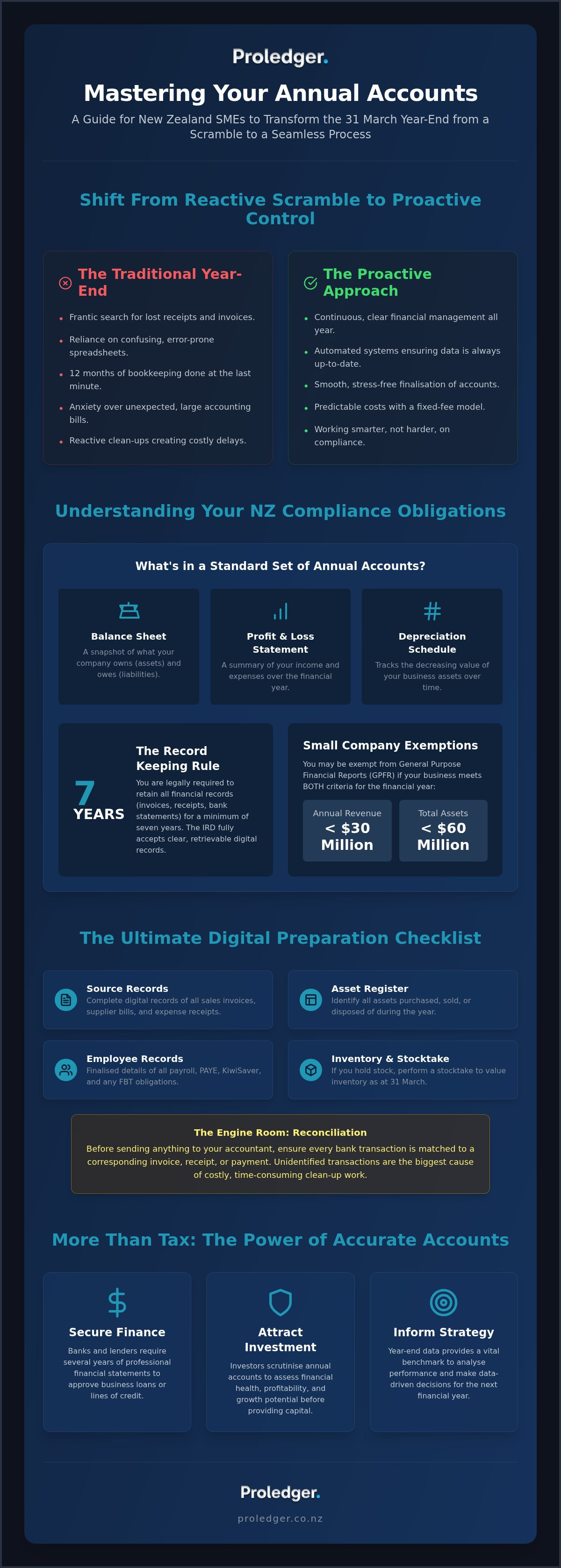
- What are Annual Accounts? In the New Zealand context, a standard set of annual accounts includes a Balance Sheet (what your company owns and owes), a Profit and Loss Statement (your income and expenses), and a Depreciation Schedule (the decreasing value of your assets).
- The 31 March Balance Date: Most NZ businesses operate on a financial year ending 31 March. This is the standard balance date for IRD compliance, setting the deadline for finalising your financial records and calculating your tax obligations.
- Minimum Reporting Requirements: The IRD sets out minimum financial reporting requirements that dictate how your accounts must be prepared. This ensures consistency and transparency, making it clear how you calculated your taxable income.
- Who is Exempt? Not every company needs to prepare extensive reports. Under the Financial Reporting Act, small companies with revenue under $30 million and assets under $60 million are generally exempt from preparing General Purpose Financial Reports (GPFR), though they must still meet IRD’s minimum standards for tax purposes. These thresholds can change, so it's wise to verify them for the current financial year.
The 7-Year Rule: Record Keeping Obligations
A common point of confusion for business owners is how long to keep financial documents. The IRD is very clear on this: you are legally required to retain all financial records for a minimum of seven years. This includes invoices, bank statements, expense receipts, and payroll data.
Fortunately, you don’t need a warehouse of filing cabinets. The IRD fully accepts digital records, provided they are clear, accurate, and easily retrievable. Storing organised scans in secure cloud storage is not only compliant but also a far more efficient way to manage your obligations.
Why Annual Accounts Matter Beyond Tax
While IRD compliance is the primary driver for annual accounts preparation, their value extends far beyond ticking a box for the tax department. Accurate, professionally prepared accounts are a powerful business tool.
- Securing Finance: Banks and lenders will almost always require several years of financial statements when you apply for a business loan or line of credit.
- Attracting Investment: If you're a startup looking to raise capital, investors will scrutinise your annual accounts to assess your financial health, profitability, and growth potential.
- Informing Strategy: Your year-end data provides a vital benchmark. It allows you to analyse what worked, what didn’t, and make data-driven decisions for your next strategic planning cycle.
The Ultimate Annual Accounts Preparation Checklist for NZ SMEs
A stress-free year-end starts with good organisation. While traditional checklists focus on gathering physical paper, a modern approach is about ensuring a smooth digital flow of information. Here’s what your accountant will need to finalise your accounts.
- Source Records: This includes a complete digital record of all sales invoices, supplier bills, expense receipts, and bank/credit card statements for the entire financial year.
- Asset Register: A list of all significant business assets. You’ll need to identify any new equipment you purchased or old assets you sold or disposed of, as this impacts your depreciation claim.
- Employee Records: Finalised details of all payroll, PAYE deductions, KiwiSaver contributions, and any Fringe Benefit Tax (FBT) obligations for the year.
- Inventory and Stocktake: If your business holds stock, you must perform a stocktake to determine the exact value of your inventory on hand as at 31 March.
Reconciling Your Accounts
Reconciliation is the engine room of accurate accounting. It’s the process of matching every single transaction in your bank account to a corresponding invoice, receipt, or payroll payment. Before you send your books to an accountant, every transaction should be identified and coded. Any "unidentified" transactions create costly and time-consuming clean-up work.
GST and Tax Compliance Review
Your annual accounts must align with the other tax filings you’ve made throughout the year. Your accountant will cross-check the total income and expenses in your Profit and Loss Statement against the figures reported in your GST returns. Ensuring your monthly bookkeeping is accurate is the best way to guarantee these figures match up seamlessly, avoiding potential IRD queries.
Eliminating the Year-End Scramble: Automation and Fixed Fees
The single biggest cause of year-end stress is leaving 12 months of bookkeeping to the last minute. The solution is to move from a manual, once-a-year event to a continuous, automated process. This is where modern accounting technology and a forward-thinking partner become essential.
- AI-Enabled Bookkeeping: Modern platforms use AI to automatically fetch bank transactions, read invoices, and categorise expenses in real-time. This dramatically reduces manual data entry and ensures your books are always up-to-date.
- Streamlined Data Flow: Implementing a simple ERP (Enterprise Resource Planning) system can create a seamless flow of data from your sales platform through to your general ledger, eliminating information silos and errors.
- The Fixed-Fee Model: The fear of a massive, hourly-billed invoice for "clean-up" work is a major pain point. A fixed-fee accountant eliminates this anxiety. You pay a predictable monthly fee, and the ongoing management of your books is included, turning annual accounts into a simple, final sign-off.
At Proledger, we manage your back-office systems so you can focus on running your business. Our combination of AI-driven platforms and expert oversight ensures your financials are accurate and always ready for reporting.
The Power of Monthly Management Accounts
Why wait until April or May to discover how your business performed last year? That’s like driving by only looking in the rearview mirror. Receiving monthly management accounts gives you a real-time view of your profitability and cash flow, allowing you to make agile decisions.
Consistent monthly reconciliation means that by the time 31 March arrives, your annual accounts are already 99% complete. This proactive approach to cash flow management transforms your financials from a historical record into a strategic asset for future growth.
Choosing a Modern NZ Accounting Partner
The accounting industry is changing. Startups and SMEs from Auckland to Christchurch are moving away from traditional firms and toward outsourced, tech-forward partners who act as a strategic part of their team. A modern partner doesn’t just process your data; they provide proactive business advisory services to help you interpret the numbers and plan ahead. For founders especially, having a scalable financial back-office from day one is critical, a topic we explore in our guide to startup bookkeeping.
Frequently Asked Questions
What is the deadline for filing annual accounts in New Zealand?
For businesses with a standard 31 March balance date, the income tax return (which is based on your annual accounts) is typically due by 7 July. However, if you use a tax agent, you may be eligible for an extension of time, often to 31 March of the following year.
Do I need an audit for my small business annual accounts?
Most small businesses in New Zealand do not require a formal audit. Audits are generally mandatory for larger companies, public entities, and certain organisations like charities. However, your bank or a potential investor may request an audit or review engagement as a condition of financing.
Can I prepare my own annual accounts using Xero or MYOB?
While software like Xero and MYOB are excellent tools for day-to-day bookkeeping, preparing compliant annual accounts involves technical knowledge of depreciation, tax adjustments, and financial reporting standards. It is highly recommended to have a qualified accountant prepare or at least review your final accounts to ensure accuracy and IRD compliance.
How much does annual accounts preparation typically cost for an NZ SME?
Costs can vary widely depending on the complexity of your business and the quality of your record-keeping. A traditional accountant billing by the hour for a messy set of books can be very expensive. A modern firm operating on a fixed-fee monthly model provides cost certainty, with annual accounts preparation often included as part of the overall service package.
Make Your Next Year-End a Non-Event
Your annual accounts shouldn't be a source of stress. They should be the natural outcome of a well-managed financial system that provides you with clarity and confidence all year round.
By embracing automation and partnering with a modern, fixed-fee firm, you can eliminate the year-end scramble for good. Focus on growing your business, knowing your compliance is handled with expert precision.
Disclaimer
The information in this article is general in nature and has been prepared for informational purposes only. It does not constitute accounting, tax, financial, or legal advice, and should not be relied upon as such.
While Proledger Consulting Limited takes care to ensure accuracy at the time of publication, laws, rates, and regulations (including NZ tax and employment law) change regularly, and this content may not reflect the most current position.
Before acting on any information in this article, we recommend you seek advice tailored to your specific circumstances. Contact us at proledger.co.nz or speak with a qualified professional. Proledger Consulting Limited accepts no liability for any loss or damage arising from reliance on this content.
© Proledger Consulting Limited. All rights reserved.
Related articles



Book a Free Consultation
Chat with Proledger about your accounting, GST, or bookkeeping needs — no obligation.
Book a Free ConsultationMeet Our Experts