

Back-Office Accounting
Excellence
Cash Flow Management for NZ Small Business: The 2026 Proactive Guide

Why does your bank balance often feel like a work of fiction, even when your sales pipeline is overflowing? It is a common frustration for Kiwi owners who find themselves chasing overdue invoices or dreading the next unpredictable accounting bill. You know that sales are only half the battle; the real victory is ensuring that money actually lands in your account. Mastering cash flow management NZ small business operations requires moving beyond reactive spreadsheets and into a proactive, tech-forward strategy.
We understand the pressure of trying to scale while worrying about missing an IRD payment deadline or losing visibility of your future tax obligations. This 2026 guide will show you how to regain control using AI-driven insights and specific local financial tactics. You will learn how to implement automated debtor follow-ups and establish predictable monthly costs that eliminate nasty surprises. We provide a clear roadmap to modernise your back office, giving you the confidence to grow your business without the constant fear of hitting a capital wall.
Key Takeaways
- Learn how to navigate the NZ compliance calendar to ensure GST and Provisional Tax payments never catch you off guard.
- Discover why modern cash flow management NZ small business owners use relies on real-time AI data rather than outdated monthly spreadsheets.
- Identify hidden capital leaks by conducting a comprehensive cash flow audit and aligning supplier terms with your customer payment cycles.
- Master the transition from reactive bookkeeping to proactive financial leadership through instant, AI-driven visibility of your bank balance.
- Eliminate the uncertainty of hourly billing by adopting a fixed-fee model that makes budgeting for your professional advisor as predictable as rent.
Table of Contents
Understanding the Cash Flow Crunch for NZ Small Businesses
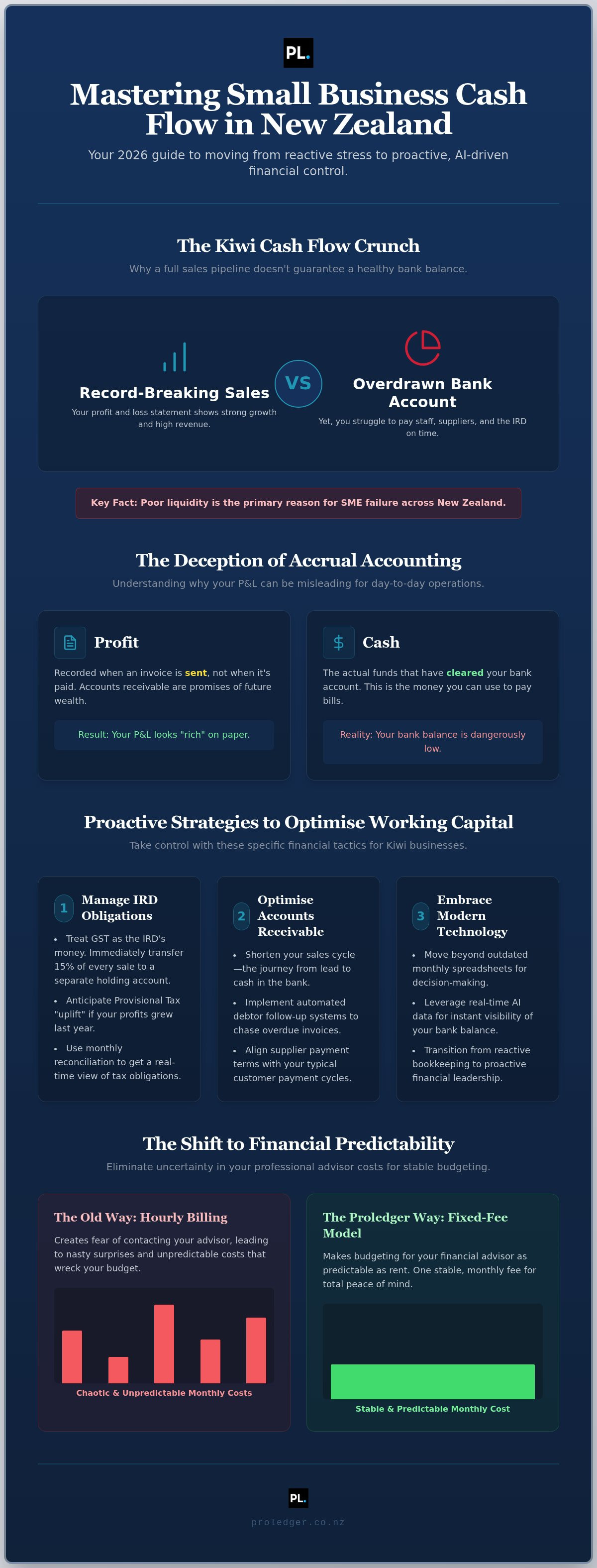
Cash flow is the literal movement of money into and out of your business bank account. It's the lifeblood of your operation, yet it remains fundamentally different from profit. You might have a record-breaking sales month on paper, but if that money hasn't cleared your account, you can't pay your staff or your suppliers. For many, Understanding Cash Flow is the difference between a thriving enterprise and a shuttered shopfront. In fact, poor liquidity is the primary reason for SME failure across New Zealand.
High-growth startups often fall into a dangerous trap. They focus entirely on revenue growth, assuming that more sales will naturally solve their financial hurdles. However, rapid growth often requires upfront investment in stock, staff, or equipment before the customer pays. This creates a "cash gap" where your liabilities grow faster than your available funds. Effective cash flow management NZ small business owners need to implement involves bridging this gap with precision and foresight.
Operating in New Zealand presents specific hurdles. Our small market size means we often rely on a few key customers, making us vulnerable if one pays late. Additionally, many sectors face extreme seasonal fluctuations; a Nelson-based tourism operator or an Auckland retail store might see huge summer turnover followed by a lean winter. Without a proactive plan, these cycles can break a business before the next peak season arrives.
Profit vs. Cash: Why Your Bank Balance Lies
Accrual accounting is standard practice, but it can be deceptive for daily operations. It records income when an invoice is sent, not when it's paid. This means your profit and loss statement might show you're "rich" while your bank account is actually overdrawn. Accounts receivable are simply promises of wealth, not actual currency you can use to pay the IRD. For a Kiwi service or retail business, working capital represents the liquid funds available to cover your daily operating expenses after you account for the money you currently owe and the payments you're waiting to receive.
The Emotional Toll of Poor Liquidity
The stress of a cash crunch is more than just financial; it's deeply personal. It's the sleepless night before a payroll run or the embarrassment of asking a long-term supplier for an extension. When liquidity is tight, you lose the ability to act fast. You might miss a prime lease opportunity in Nelson or be unable to stock up for a major Auckland trade show because your capital is tied up elsewhere. Building a "peace of mind" buffer isn't just a luxury. It's a strategic necessity that allows you to focus on your passion rather than constant survival.
The Anatomy of a Healthy Cash Flow Cycle in New Zealand
Success in the local market requires more than just high sales volumes. It demands a deep understanding of the rhythm that dictates when money moves. For many, cash flow management NZ small business owners must master involves synchronising their sales cycle with the relentless "NZ Compliance Calendar." Unlike other markets, our tax obligations like GST, FBT, and Provisional Tax act as significant, non-negotiable cash outflows that can cripple a business if they aren't factored into daily operations.
Shortening your sales cycle is the most direct way to improve liquidity. This journey begins at the initial lead and only ends when the cash hits your bank account. In New Zealand, seasonality plays a massive role in this timing. A Nelson-based business might experience a summer surge in tourism or agriculture, while an Auckland firm might struggle during the January holiday lull when the city effectively shuts down. Preparing for these peaks and troughs requires you to look at your inventory with a critical eye. Dead stock sitting on a shelf is simply cash that you cannot use to pay your bills or invest in growth.
Managing the IRD: Tax as a Cash Flow Variable
Treating GST as your own money is a common mistake that leads to a seasonal crisis. Since GST is a flat 15%, you should ideally move this portion of every sale into a separate holding account immediately. The real danger often lies in Provisional Tax "uplift." If your profit grew significantly last year, the IRD expects you to pay more in advance this year. This can catch growing firms off-guard, especially if current trading has slowed. Regular monthly reconciliation ensures you have a real-time view of these obligations, preventing year-end shocks when terminal tax falls due on July 7, or April 7 for those using a tax agent.
Optimising Accounts Receivable
Your payment terms define your cash flow health. While the traditional "20th of the following month" is common in New Zealand, many modern businesses are shifting to 7-day terms to accelerate their cycle. Chasing debt the "Kiwi way" involves a balance of firmness and relationship management. You don't want to alienate a long-term partner, but you cannot afford to act as their bank. Implementing AI-driven automation allows you to send polite, branded reminders before an invoice is even due, removing the awkwardness of manual follow-ups and ensuring your invoices stay at the top of your customer's payment pile.
Moving Beyond Spreadsheets: AI and Real-Time Insights
Traditional spreadsheets are essentially historical documents. They tell you what happened weeks ago, but they offer very little guidance for the decisions you need to make this morning. By the time you've finished manual data entry, your financial landscape has already changed. Modern cash flow management NZ small business leaders now employ relies on dynamic data flows that update in real-time. This shift from reactive bookkeeping to proactive forecasting is the only way to stay ahead in a volatile market.
Integrating an ERP system streamlines your entire back-office by connecting sales, inventory, and payroll into a single source of truth. This connectivity removes the operational silos that lead to blind spots in your bank balance. When every transaction is captured instantly, you gain a level of visibility that manual systems simply cannot match. It transforms your accounts from a compliance chore into a strategic asset for growth. You gain the ability to model different scenarios, such as the impact of a new hire or a bulk stock purchase, before you commit a single dollar.
AI Bookkeeping: Accuracy Without the Effort
AI finance automation doesn't just record data; it intelligently organises it. By automatically categorising transactions based on verified historical patterns, it ensures your books are reconciled every single day. This automation significantly reduces human error in complex areas like GST and payroll calculations, where a minor slip can lead to costly IRD penalties. By continuously scanning your financial history, AI algorithms identify subtle shifts in spending and revenue patterns to flag potential cash flow trends weeks before they escalate into critical capital shortages. This early warning system allows you to adjust your strategy while you still have room to manoeuvre.
Manual vs. Automated Financial Management
The difference between manual entry and automated reporting is measured in hours of reclaimed time. For most Kiwi owners, the cost-benefit analysis of moving to an AI-driven firm like Proledger is undeniable. You stop paying an hourly rate for the clerical task of typing and start investing in the strategic insights that actually drive your business forward. We're seeing Christchurch startups lead this transition, ditching traditional hourly accountants for tech-forward partners who provide instant visibility through mobile-friendly dashboards. This allows founders to focus on scaling their operations while their financial back-office runs with surgical precision on autopilot. It is no longer about looking back at last month's P&L; it is about having the cash flow management NZ small business owners need to predict the next six months with total confidence.
Practical Strategies to Optimise Your Working Capital
Optimising your working capital is about fine-tuning the engine of your business. It requires a disciplined approach to how money moves within your four walls. Start by conducting a 'Cash Flow Audit' to identify where capital is leaking. You might find forgotten software subscriptions or inefficient inventory orders that tie up cash. Once you have a clear picture, renegotiate your supplier terms. The goal is to align your outflows with your customer payment cycles, ensuring you aren't paying for raw materials weeks before you receive payment for the finished product.
Effective cash flow management NZ small business owners implement also involves reviewing your pricing model. If your margins are too slim, you might be busy but perpetually broke. High volume with low margin is a recipe for a liquidity crisis. Additionally, you should outsource your bookkeeping and payroll to ensure you never miss a filing deadline. With the adult minimum wage at $23.95 per hour as of April 2026, and the ACC earners' levy at 1.75%, manual calculations are a high-risk liability that can lead to expensive IRD penalties.
The Power of the 13-Week Forecast
A 13-week forecast is the 'sweet spot' for Kiwi SMEs. It covers a full quarter, allowing you to see beyond the immediate horizon without losing accuracy. This view helps you identify 'pinch points' where seasonal expenses or tax obligations might exceed your income. Strategic cash flow management NZ small business requires looking at the next 13 weeks to make major decisions, such as when to hire your next staff member. If the forecast shows a dip in eight weeks, you can adjust your spending now to protect your buffer.
Negotiating with Suppliers and Creditors
Maintaining strong relationships with your creditors is essential for flexibility. When asking for longer payment terms, be transparent. Use your management accounts to prove your business's health and show that you have a plan. Suppliers are often willing to extend terms if they see you are organised and reliable. Conversely, look for early-payment discounts. If you have a healthy cash buffer, taking a 2% discount for paying early can provide a better return than leaving that money in a low-interest business account. It's a strategic move that strengthens your supply chain while improving your bottom line.
How Proledger’s Fixed-Fee Model Stabilises Your Cash Flow
Traditional hourly billing is a fundamental barrier to healthy financial communication. It turns your professional advisor into a variable expense that spikes exactly when your business is facing its most complex challenges. For many, the "surprise bill" that arrives after a series of phone calls or a complicated tax season is the ultimate enemy of cash flow management NZ small business owners are trying to master. It creates a hesitation to reach out for help, often leading to small issues snowballing into significant capital crises.
Treating your accounting fee as a fixed monthly overhead, similar to your rent or utilities, removes this friction entirely. This model provides the predictability you need to build accurate 13-week forecasts without worrying about unbudgeted professional fees. You gain a partner who is incentivised to make your systems as efficient as possible, rather than a provider who profits from the time it takes to fix manual errors. By consolidating your bookkeeping, payroll, and GST filing into one flat monthly payment, you simplify your accounts payable and keep your working capital focused on growth.
A Comprehensive Back-Office Solution
Proledger acts as a fully integrated, outsourced finance department for firms from Richmond to Auckland. Our service goes far beyond simple data entry. We manage the entire lifecycle of your financial data, ensuring that monthly reconciliation is handled with surgical precision. This high-quality data is the foundation for the AI-driven insights we provide through our analyst platform. Whether you need an ERP implementation to connect your sales channels or AI finance automation to handle high-volume transactions, our team ensures your tech stack works for you. Startups in Christchurch and established retailers in Nelson use this infrastructure to maintain a level of financial sophistication that was previously only available to large corporations.
Focus on Growth, Not Admin
The true return on investment when delegating your financial management is the reclamation of your own time. Business owners are often the most expensive bookkeepers in their own companies. One Nelson-based business recently saved 10 hours a week on bookkeeping after transitioning to our automated systems and fixed-fee support. This is time that can be redirected toward strategy, customer acquisition, and product development. When you aren't bogged down in the minutiae of payroll or chasing overdue invoices, you have the mental clarity to lead your business with confidence. Stop reacting to your bank balance and start directing it. Organise a fixed-fee quote for your business today and secure the professional partnership your growth deserves.
Secure Your Financial Future with Proactive Capital Control
Mastering your bank balance is the most significant step you can take toward long-term stability. By moving away from outdated spreadsheets and embracing AI-driven financial insights, you gain the real-time visibility needed to make bold decisions. You've seen how a structured 13-week forecast and a deep understanding of the NZ compliance calendar can prevent seasonal crunches. Effective cash flow management NZ small business owners prioritise isn't just about survival; it's about building the infrastructure to scale without fear.
Proledger provides the expert support you need across Auckland, Christchurch, Nelson, and Richmond. Our fixed-fee model eliminates surprise accounting bills, allowing you to budget with total precision. We handle the technical complexities of GST, payroll, and annual accounts so you can focus on your passion. Discover how Proledger’s fixed-fee accounting can stabilise your cash flow and give you the clarity to grow. You have the vision for your business; let us provide the financial foundation to help you reach it.
Frequently Asked Questions
What is the best way to manage cash flow for a startup in NZ?
The most effective way is to implement real-time cloud accounting and automated systems from day one. You shouldn't wait for your revenue to reach a certain threshold before seeking professional cash flow management NZ small business support. Early adoption of digital tools ensures you have visibility over every dollar from the start, preventing the common trap where sales increase but bank balances disappear.
How do I calculate my business's cash flow break-even point?
Calculate your break-even point by dividing your total fixed operating costs by your gross profit margin percentage. You must remember that a cash flow break-even is different from a profit break-even. It needs to include non-expense outflows like loan principal repayments, asset purchases, and your own drawings to provide a true picture of your liquidity requirements.
Can AI really replace a traditional bookkeeper for my small business?
AI cannot replace the strategic oversight of an expert, but it does replace the tedious manual data entry of traditional bookkeeping. It acts as a high-speed assistant that categorises transactions and identifies patterns with surgical precision. This shift allows your advisor to focus on high-level growth strategies and proactive forecasting rather than just balancing the books after the fact.
What are the common GST filing mistakes that affect cash flow?
The most frequent error is failing to set aside the 15% GST portion of every sale into a separate holding account. Many owners also accidentally claim GST on items that don't include it, such as bank fees, interest payments, or private drawings. These mistakes lead to unexpected IRD bills and penalties that can suddenly drain your available working capital during a lean month.
How much should a small business keep in cash reserves in NZ?
Aim to keep between three and six months of operating expenses in a liquid cash reserve. With the annual inflation rate sitting at 3.1% in 2026, your operating costs are likely rising, so your reserve needs to be reviewed and adjusted regularly. Having this buffer ensures you can navigate economic shifts or sudden dips in demand without needing to take on high-interest emergency debt.
Is invoice financing a good idea for a struggling business?
Invoice financing can provide a quick liquidity injection for high-growth firms, but it is often an expensive bandage for a struggling business. It treats the symptom rather than the underlying cause of the cash crunch. You are usually better off renegotiating supplier terms or implementing automated debtor follow-ups before committing to the high fees associated with factoring services.
How does fixed-fee accounting help with my monthly budgeting?
Fixed-fee accounting eliminates the "surprise bill" problem by turning your professional advice into a predictable monthly overhead. You can budget for your accounting costs with total certainty, just like you do for your rent or power. This transparency encourages more frequent communication with your advisor, which leads to more consistent cash flow management NZ small business results.
What should I do if I can't pay my IRD tax bill on time?
Contact the IRD immediately to discuss an instalment arrangement if you realise you cannot meet a payment deadline. They are far more likely to be lenient if you reach out before the due date rather than waiting for them to chase you. Remember that for most individuals, terminal tax is due on July 7, 2026; however, this is extended to April 7, 2027, if you are linked to a tax agent.
Disclaimer
The information in this article is general in nature and has been prepared for informational purposes only. It does not constitute accounting, tax, financial, or legal advice, and should not be relied upon as such.
While Proledger Consulting Limited takes care to ensure accuracy at the time of publication, laws, rates, and regulations (including NZ tax and employment law) change regularly, and this content may not reflect the most current position.
Before acting on any information in this article, we recommend you seek advice tailored to your specific circumstances. Contact us at proledger.co.nz or speak with a qualified professional. Proledger Consulting Limited accepts no liability for any loss or damage arising from reliance on this content.
© Proledger Consulting Limited. All rights reserved.
Frequently Asked Questions
Related articles



Book a Free Consultation
Chat with Proledger about your accounting, GST, or bookkeeping needs — no obligation.
Book a Free ConsultationMeet Our Experts