

Back-Office Accounting
Excellence
Startup Bookkeeping New Zealand: The 2026 Founder’s Guide to Scalable Finance

Table of Contents
What is Startup Bookkeeping in the New Zealand Context?
For a New Zealand founder in 2026, bookkeeping is no longer about tedious data entry or historical record-keeping. It's the strategic engine of your business, transforming raw financial data into a powerful tool for compliance, investor confidence, and scalable growth. It is the process of maintaining accurate, real-time financial records to ensure Inland Revenue (IRD) compliance and investor readiness.
While traditional views might see it as simply "doing the books," modern startup bookkeeping in New Zealand is a dynamic function. It’s the foundation upon which all critical financial management rests. Without clean, organised, and up-to-date books, you cannot generate accurate reports, forecast cash flow, or make informed decisions about your company’s future. It’s the difference between navigating with a precise GPS and steering with a hand-drawn map.
The IRD mandates meticulous record-keeping for a reason. Every transaction, from a software subscription to a major client payment, has implications for your Goods and Services Tax (GST) and income tax obligations. Getting this wrong can lead to costly penalties, audits, and immense stress—distractions no founder can afford. Therefore, robust bookkeeping isn't just good practice; it's a legal necessity for operating in New Zealand.
The Role of the IRD and Compliance
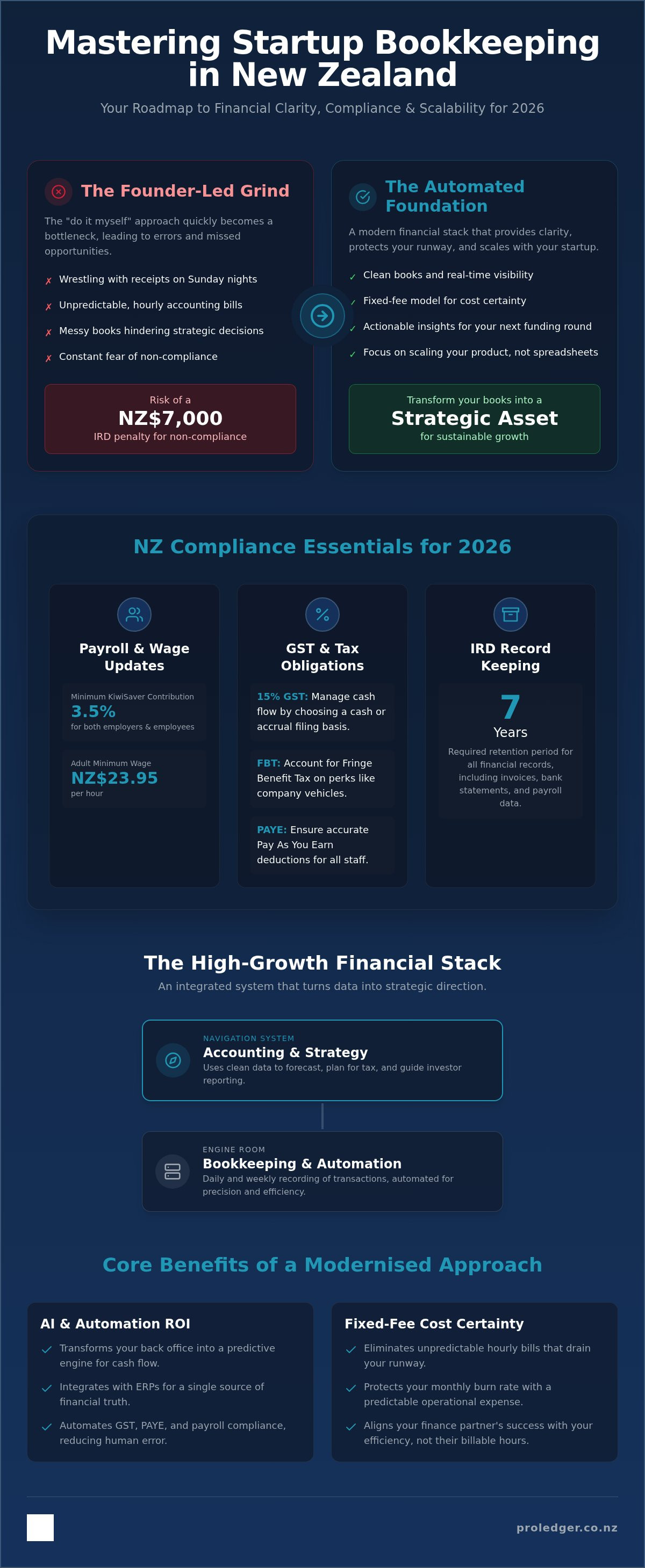
Navigating the New Zealand tax landscape is a core challenge for any startup. The Inland Revenue Department (IRD) sets clear expectations for businesses, and compliance is non-negotiable. For an early-stage company, understanding your obligations for GST, Pay As You Earn (PAYE), and Fringe Benefit Tax (FBT) is the first step towards financial stability.
- GST (Goods and Services Tax): If your turnover exceeds (or is likely to exceed) $60,000 in any 12-month period, you must register for GST. This involves filing regular returns and paying 15% on your goods and services.
- PAYE (Pay As You Earn): As soon as you hire your first employee, you become an employer and must deduct PAYE tax from their salary or wages. This also includes managing KiwiSaver contributions and student loan repayments.
- FBT (Fringe Benefit Tax): If you provide non-cash benefits to employees, such as a company car for personal use or subsidised gym memberships, you may be liable for FBT.
Early-stage startups often fall into common compliance traps, such as misclaiming home office expenses, incorrectly categorising capital expenditure, or failing to keep adequate records for entertainment costs. These seemingly small errors can compound over time. Furthermore, the 31 March financial year-end is a critical date for most Kiwi businesses, marking the deadline for finalising accounts and preparing for income tax filings.
Bookkeeping vs. Accounting: What Startups Need
Founders often use the terms "bookkeeping" and "accounting" interchangeably, but they represent distinct and complementary functions. Think of it this way: bookkeeping is the engine room of your financial operations, while accounting is the navigation on the bridge.
Bookkeeping is the systematic process of recording, categorising, and reconciling daily financial transactions. It's the groundwork that ensures every dollar is accounted for. Accounting takes this organised data and uses it for higher-level analysis, financial reporting, tax planning, and strategic advice. One cannot function effectively without the other.
A crucial benefit of maintaining clean, professionally managed books throughout the year is a significant reduction in year-end accounting fees. When an accountant receives a tidy, well-reconciled ledger, their job shifts from costly clean-up work to high-value strategic analysis. This transition is vital. In the early days, a founder might manage the books on a spreadsheet. But as the business grows, transactions multiply, and compliance complexity increases, transitioning to a professional outsourced bookkeeping service becomes essential for scalability and peace of mind.
The Core Components of an NZ Startup's Financial Stack
A scalable financial stack is more than just a subscription to accounting software. It’s an integrated system of processes and services designed to provide clarity, ensure compliance, and support growth. For a New Zealand startup, this stack must be built to handle local regulations and business realities. The core components work together to create a seamless back-office engine.
- Payroll NZ: This involves accurately managing employee payments, deducting PAYE, handling KiwiSaver contributions, and ensuring compliance with New Zealand's complex employment laws.
- GST and FBT Filing: Navigating the bi-monthly or six-monthly GST return cycles is a fundamental requirement, along with correctly calculating and filing any FBT obligations.
- Monthly Reconciliation: This is the non-negotiable process of ensuring the transactions in your accounting software perfectly match your bank and credit card statements every single month, catching errors before they become major problems.
- Annual Accounts: At the end of the financial year, all your financial data is compiled into a formal balance sheet and profit & loss statement, which form the basis for your annual tax returns.
Payroll and KiwiSaver Management
Payroll in New Zealand can be surprisingly complex, particularly due to the intricacies of the Holidays Act. Calculating leave entitlements, final pay, and public holiday payments requires precision to avoid compliance issues. For a small but growing team, manual payroll calculations are not just time-consuming but also a significant source of risk.
Automating KiwiSaver contributions is another critical element. Ensuring the correct employer and employee contributions are calculated and paid on time is essential for meeting your obligations and supporting your team's financial future. For startups in regional hubs like Richmond and Nelson, outsourced payroll offers access to specialised expertise without the overhead of an in-house finance team. It frees up founders to focus on product development and customer acquisition, confident that their team is being paid correctly and on time.
GST Returns and Tax Compliance
One of the first major financial decisions a startup founder makes is whether to file GST returns on a cash or accrual basis. The cash basis accounts for revenue and expenses when money actually changes hands, which can be simpler for managing cash flow. The accrual basis records them when they are invoiced or billed, offering a more accurate picture of long-term profitability. Choosing the right one depends on your business model and cash flow cycle.
Fringe Benefit Tax (FBT) is another area where startups need clear guidance. If a founder uses a company-owned vehicle for personal travel, this creates an FBT liability that must be calculated and paid to the IRD. Understanding these nuances from day one prevents surprise tax bills down the line. Using a service like Proledger, you can automate much of this process. Our platform helps ensure GST is calculated correctly and filed directly with the IRD, removing manual steps and reducing the margin for error.
Fixed-Fee vs. Hourly Billing: The ROI of Cost Certainty
For decades, the standard model for professional services has been the billable hour. However, for a startup managing a tight burn rate, this model is fundamentally broken. Hourly billing creates a direct conflict of interest: the longer a task takes, the more the firm earns. This incentivises inefficiency and, more importantly, creates crippling financial uncertainty for the client.
The "No Surprise" bill philosophy is central to the modern approach. A fixed-fee or subscription model aligns the interests of the bookkeeping firm with the startup. The goal becomes efficiency, accuracy, and proactive support, not logging hours. This cost certainty is one of the most powerful tools a founder can have. When you know exactly what your accounting will cost each month, you can allocate capital with confidence, forecast your cash flow accurately, and build a sustainable growth plan. For more on this, see our guide to predictable accounting with fixed-fee bookkeeping.
When comparing the total cost of ownership, a fixed-fee professional service often provides far greater value than a DIY software approach combined with a year-end accountant. The subscription includes ongoing support, compliance management, and strategic insights—services that would generate unpredictable hourly bills in a traditional model.
The Problem with Traditional Hourly Accounting
The biggest issue with hourly billing is the fear it creates. Founders hesitate to pick up the phone to ask a quick question, worried it will trigger a 15-minute charge on their next invoice. This communication barrier prevents proactive problem-solving and can lead to small issues escalating into major financial headaches. Startups need a partner they can talk to, not a meter they are afraid to run.
Inconsistent monthly expenses from a traditional accountant make cash flow forecasting nearly impossible. One month might be a few hundred dollars, while the next could be several thousand after a complex query or quarterly report. This volatility is poison to a startup's financial planning. Furthermore, traditional firms often prioritise their larger, more established clients, leaving startups feeling like a low priority and waiting days for critical answers.
Benefits of the Proledger Subscription Model
A subscription model flips the script entirely. With Proledger, you get unlimited support within your package. This means you can ask questions, seek advice, and resolve issues without ever worrying about an extra bill. We encourage communication because it leads to better financial outcomes.
Our model is built for scale. We offer scalable tiers that grow with your business, whether you're a seed-stage startup in Christchurch or a rapidly expanding tech company in Auckland. You only pay for what you need, with the ability to seamlessly upgrade your services as your revenue and team size increase. Crucially, our integrated AI insights and management reporting are included in the monthly fee, transforming your bookkeeping from a compliance cost into a strategic asset.
Implementing AI and Automation in Your Back Office
Modern startup bookkeeping in New Zealand has moved far beyond the simple automation of bank feeds. The next frontier is leveraging Artificial Intelligence (AI) to provide deep, predictive insights and automate complex workflows. While tools like Xero are excellent for capturing data, AI is what helps you interpret it at speed and scale.
True automation means using AI to predict cash flow trends, flag spending anomalies, and categorise expenses with near-perfect accuracy. This frees up human experts to focus on high-value strategic advice. For startups struggling with manual processes, understanding how to better manage their finances is critical. Proactive cash flow management for NZ small business becomes possible when AI can analyse patterns and forecast future positions based on historical data and upcoming payables.
As a startup grows, it may outgrow basic software and require an integrated Enterprise Resource Planning (ERP) system to manage inventory, sales, and finance in one place. AI-enabled data analyst platforms provide another leap forward, giving founders instant, natural-language answers to complex financial questions like, "What was our customer acquisition cost in Q2?" or "Project our runway based on the current hiring plan." This level of automation not only saves countless hours but also dramatically reduces the risk of human error in management accounts.
The Roadmap to ERP Implementation
Knowing when to graduate from Xero or MYOB to a full ERP system is a critical growth decision. The signs are usually clear: increasing inventory complexity, a need for multi-currency reporting, disconnected data silos between sales and finance, or operations that have simply outpaced the software's capabilities. Making the leap too early is a waste of capital, but waiting too long can stifle growth.
Proledger manages this entire transition. We help you identify the right time to migrate and then oversee the implementation process to ensure a seamless switch. Our primary focus is on maintaining data integrity. A poorly managed migration can corrupt years of financial history, creating a nightmare for reporting and compliance. We ensure that every transaction, customer record, and historical report is transferred accurately, setting your business up for its next phase of growth on a robust, scalable platform.
AI Finance Automation in Action
What does AI-driven automation look like in practice for a New Zealand startup? It’s about tangible, time-saving results that directly impact your bottom line and decision-making capabilities.
- Expense Categorisation: AI algorithms can learn your spending patterns to categorise incoming transactions with over 99% accuracy, virtually eliminating the tedious manual task of coding bills and receipts.
- Real-Time Reporting: Instead of waiting until the end of the month, AI can generate real-time management accounts on demand. This allows you to walk into a board meeting with up-to-the-minute data on revenue, expenses, and profitability.
- Audit-Ready Books: Automation creates a perfect, digital "paper trail." Every transaction is backed by source documents and clear categorisation, making your books audit-ready from day one. In 2026, this level of preparedness is the standard for investor-backed companies.
Scaling Your Startup with Proledger’s Integrated Support
Growth requires more than just great software; it demands an operational infrastructure that can scale without breaking. Proledger delivers this through a unique hybrid model, providing ambitious startups in Nelson, Richmond, and across New Zealand with the kind of robust back-office support typically reserved for large corporations.
This is about transforming your financial data from a historical record into a forward-looking strategic asset. With clean books and real-time insights, you can make data-driven decisions about hiring, marketing spend, and product development. Our role extends beyond compliance to strategic business advisory. We help you use your financials to build a compelling case for investors, apply for NZ-specific R&D tax credits, and identify opportunities for growth. Local expertise matters, especially when navigating the specific economic landscape of Auckland or Christchurch.
Local Management, Global Delivery
Our model is designed to give you the best of both worlds: local expertise and global scale. The entire service is managed by our team of experienced professionals based here in New Zealand, including in hubs like Richmond and Nelson. They understand the nuances of the IRD, Kiwi business culture, and the specific challenges facing NZ startups. They are your primary point of contact, ensuring all work meets the highest standards of quality and compliance.
To provide cost-effective scale and handle high-volume transaction processing, we have a strategic partnership with a leading global accounting firm. This allows us to leverage world-class systems and a deep pool of talent to manage the heavy lifting of data processing and reconciliation efficiently. This hybrid structure ensures you receive premium, locally-managed service at a price point that makes sense for a growing startup. We maintain rigorous data security and privacy protocols across our entire delivery model, giving you complete peace of mind.
Next Steps for Your NZ Startup
Getting your financial foundation right is one of the most impactful decisions you can make for your startup's future. It’s time to move beyond unpredictable bills and manual admin and embrace a scalable, tech-driven approach.
- Book a Financial Health Check: Start with a no-obligation consultation with a Proledger advisor to assess your current bookkeeping and compliance setup.
- Customise Your Package: We will design a fixed-fee accounting package that fits your current stage, whether you're at the pre-seed, seed, or Series A level.
- Focus on Growth: Let us handle your back office so you can focus on what you do best—building an incredible company.
Organise a fixed-fee quote for your startup today
Frequently Asked Questions about Startup Bookkeeping in New Zealand
Do I need a professional bookkeeper if I already use Xero?Yes, in most cases. Xero is a powerful tool, but it's only as good as the data put into it. A professional bookkeeper ensures transactions are categorised correctly according to NZ tax law, reconciles accounts accurately, manages payroll complexities, and provides a layer of strategic oversight that software alone cannot offer. They turn the tool into a solution.
What are the common GST mistakes NZ startups make?Common mistakes include registering for GST too late, incorrectly claiming GST on personal expenses or entertainment, failing to account for GST on assets purchased, and errors in choosing between cash and accrual accounting schemes. These can lead to IRD penalties and cash flow problems.
How much does startup bookkeeping cost in New Zealand?Costs vary widely. Traditional hourly rates can range from $50 to $150+ per hour, leading to unpredictable monthly bills. Proledger offers fixed-fee monthly packages tailored to your transaction volume and complexity, providing cost certainty and eliminating surprise invoices. This allows you to budget effectively.
Can Proledger help with R&D tax incentive applications?Absolutely. The Research and Development Tax Incentive (RDTI) requires meticulous records of eligible expenditure. Our precise bookkeeping ensures you have the accurate, audit-ready financial data needed to support a successful RDTI claim, maximising your return from this valuable government programme.
What is the difference between a bookkeeper and a business advisor?A traditional bookkeeper records and organises financial transactions. A modern business advisor uses that accurate financial data to provide strategic insights. At Proledger, we integrate both roles. Our service ensures your books are pristine, and our team acts as an advisor, helping you interpret the numbers to make smarter business decisions.
How does the offshore partnership work for my NZ business?Our model uses a hybrid approach. Your account is managed by our senior, NZ-based professionals who are your main point of contact and ensure all work meets local compliance standards. The high-volume, process-driven tasks are handled by our skilled delivery team through our partnership with a global accounting firm. This gives you top-tier local expertise combined with global efficiency and scale.
Is my startup too small for ERP implementation?Possibly, but it's important to plan ahead. Most startups begin on systems like Xero. We help you recognise the trigger points for an upgrade—such as complex inventory, multi-national sales, or high transaction volumes. We provide a clear roadmap so you can transition to an ERP at the right time, without over-investing too early.
How do I switch from my current hourly-rate accountant to Proledger?The process is seamless. We handle the entire migration. After you engage us, we will contact your previous accountant to retrieve all necessary historical data and files. We manage the setup on our systems and ensure a smooth transition with no disruption to your operations. You simply get to enjoy the benefits of a fixed-fee, scalable service from day one.
Disclaimer
The information in this article is general in nature and has been prepared for informational purposes only. It does not constitute accounting, tax, financial, or legal advice, and should not be relied upon as such.
While Proledger Consulting Limited takes care to ensure accuracy at the time of publication, laws, rates, and regulations (including NZ tax and employment law) change regularly, and this content may not reflect the most current position.
Before acting on any information in this article, we recommend you seek advice tailored to your specific circumstances. Contact us at proledger.co.nz or speak with a qualified professional. Proledger Consulting Limited accepts no liability for any loss or damage arising from reliance on this content.
© Proledger Consulting Limited. All rights reserved.
Related articles



Book a Free Consultation
Chat with Proledger about your accounting, GST, or bookkeeping needs — no obligation.
Book a Free ConsultationMeet Our Experts