

Back-Office Accounting
Excellence
Trans-Tasman Tax Guide for Auckland & Nelson Businesses

What if the greatest risk to your business expansion isn't a lack of customers, but the invisible border of the Australian Taxation Office? Crossing the ditch from Auckland or Nelson is a bold strategic move, yet many owners hesitate because the rules feel like a moving target. Please note that this is only Tax education on Trans-Tasman tax, designed to give you the clarity needed to scale without the stress of double taxation.
It's natural to feel overwhelmed by the differences in GST rates or the looming 2027 changes to Australian Capital Gains Tax. You want to protect your assets without being drained by the high costs of traditional international specialists. This guide provides a clear framework for managing your obligations in both jurisdictions. We'll explore residency tie-breaker rules, the 2026 Double Tax Agreement updates, and how to create a predictable accounting structure for your Trans-Tasman operations. By understanding these complexities now, you can focus on growth with total financial confidence.
Key Takeaways
- Define your residency status using the 183-day rule and Permanent Place of Abode tests to avoid accidental non-compliance with the ATO.
- Navigate the Double Tax Agreement (DTA) to protect your income from being taxed twice, noting that this is only Tax education on Trans-Tasman tax.
- Identify exactly when your New Zealand export business must register for Australian GST to maintain a seamless cross-border operation.
- Mitigate the Capital Gains Tax shock on your New Zealand assets by understanding how the ATO treats property once you become an Australian resident.
- Implement cloud accounting and monthly reconciliations to manage dual-currency ledgers and ensure your back office remains scalable and compliant.
Table of Contents
Understanding Residency and the Double Tax Agreement (DTA)
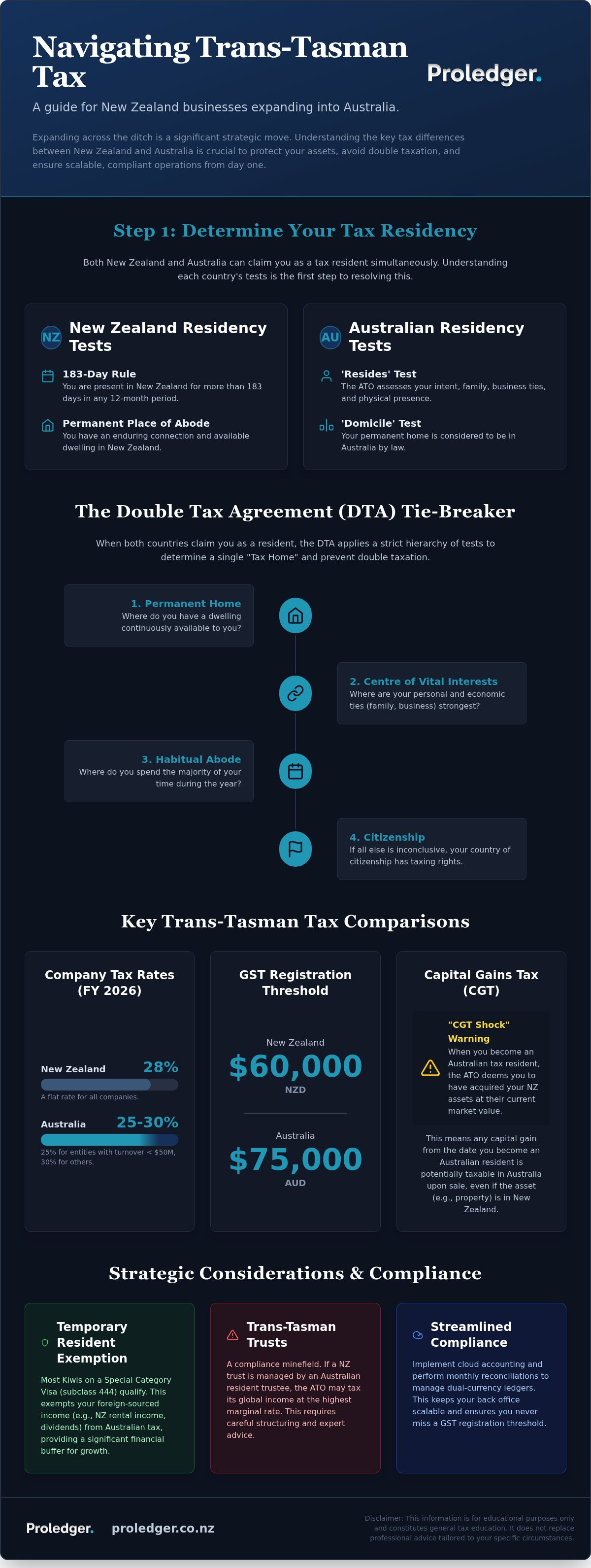
Determining your tax residency is the first step in protecting your global wealth. It's a complex area because both New Zealand and Australia may claim you as a resident simultaneously. In New Zealand, you generally become a tax resident if you're present for more than 183 days in any 12-month period or have a "Permanent Place of Abode" in the country. Conversely, the ATO applies the "Resides" and "Domicile" tests. These look at your intent, family ties, and business assets to decide where you truly belong. Because Australia-New Zealand relations are so integrated, the Double Tax Agreement (DTA) exists to ensure you aren't hit twice. Please keep in mind that this is only Tax education on Trans-Tasman tax; it's vital to confirm your specific "Tax Home" well before the end of the financial year to avoid costly surprises.
The Tie-Breaker Rules: Who Gets Your Tax?
When both nations claim you as a resident, the DTA uses a series of tie-breaker tests to resolve the conflict. This hierarchy is strict and helps decide which country has the primary right to tax your income. The authorities will look at several key factors:
- Permanent Home: Where do you have a dwelling available to you at all times?
- Centre of Vital Interests: Where are your personal and economic ties, such as family and business, strongest?
- Habitual Abode: Where do you spend the majority of your time during the year?
If these steps are inconclusive, the decision often falls to your citizenship status. Deciding this early prevents messy, protracted disputes with the IRD or ATO.
Temporary Resident Exemptions in Australia
Many New Zealanders moving across the Tasman are surprised to find they may qualify as "temporary residents" for tax purposes. Under the Special Category Visa (SCV) subclass 444, most Kiwis are exempt from paying Australian tax on foreign-sourced income, such as rent from a property in Auckland or dividends from a Nelson-based company. This provides a significant financial buffer while you establish your Australian operations. It's a strategic advantage that allows you to reinvest capital into your business growth rather than losing it to unnecessary tax leakage.
Key Trans-Tasman Tax Challenges: CGT, GST, and Trusts
Moving across the Tasman often triggers a "Capital Gains Tax Shock" that catches many Auckland and Nelson business owners off guard. When you become an Australian tax resident, the ATO deems you to have acquired your New Zealand assets at their current market value on that specific date. If you eventually sell that Auckland family home or a commercial unit in Nelson, the gain accrued from your arrival date is taxable in Australia. It's vital to recognise that this is only Tax education on Trans-Tasman tax, designed to highlight these potential traps before you commit to a move.
Company tax structures also require a careful comparison. For the 2026 financial year, New Zealand maintains a flat company tax rate of 28%. Australia operates a two-tiered system: a 25% rate for "base rate entities" with an aggregated turnover under $50 million, and 30% for all other companies. Choosing where to book your profits can significantly impact your bottom line, especially when combined with the complexities of "Trans-Tasman Trusts." Keeping a New Zealand trust while living in Australia is often a compliance minefield. The ATO may tax the trust's global income at the highest marginal rate if it's managed by an Australian resident trustee.
Property Investment and the Bright-Line Test
Auckland and Christchurch landlords must navigate the interaction between the New Zealand bright-line test and Australian CGT. As of 1 July 2024, the New Zealand bright-line period is two years. If you sell within this window, the profit is taxed as income in NZ. However, even if you're outside this period, the Australian tax system may still claim a portion of the gain. Understanding the nuances of Residential vs Commercial Property Rental Tax in NZ is a prerequisite for any investor looking to maintain a portfolio across both countries.
GST Obligations for Cross-Border Services
Determining the "Place of Supply" is the most common hurdle for digital services and consultants. If you're a New Zealand exporter, you must register for Australian GST if your Australian turnover exceeds $75,000 AUD. Conversely, the NZ threshold remains at $60,000 NZD. Managing these dual obligations requires precision to avoid double-charging your clients. Following a structured approach to GST Filing NZ ensures your domestic compliance is rock solid while you scale abroad. A fixed-fee compliance partner can help monitor these thresholds monthly, ensuring you never miss a registration deadline.
Streamlining Trans-Tasman Compliance for Your Business
Managing a business across two tax jurisdictions requires more than just a spreadsheet; it demands a sophisticated digital backbone. Cloud platforms like Xero are essential for Auckland and Nelson SMEs, allowing you to maintain dual-currency ledgers that update in real-time. This visibility ensures you aren't guessing your liability when the exchange rate fluctuates. While this is only Tax education on Trans-Tasman tax, the practical application of these tools is what prevents accidental non-compliance. Real-time data lets you see exactly how your Australian expansion impacts your New Zealand cash flow.
Monthly reconciliation is the non-negotiable standard for any business with cross-border transactions. Waiting until the end of the financial year to sort through inter-company transfers is a recipe for disaster. We use AI-enabled data platforms to spot tax anomalies instantly, long before they ever reach the IRD or ATO. This proactive approach, combined with a fixed-fee accounting model, gives you predictable costs. It transforms your back office from a source of stress into a streamlined engine for growth.
ERP Implementation for Multi-Jurisdictional SMEs
Integrated systems are the only way to manage payroll and GST across two countries without doubling your administrative burden. Modern ERP setups ensure that your New Zealand and Australian obligations are met from a single source of truth. Proledger assists with ERP implementation to automate your cross-border reporting. We focus on connecting your sales data directly to your tax filings, reducing manual entry errors and ensuring your "Place of Supply" rules are applied correctly every time.
Your Trans-Tasman Compliance Checklist
Success in two markets requires a rhythmic approach to compliance. Remember that this is only Tax education on Trans-Tasman tax, so use this checklist as a starting point for your internal reviews:
- Quarterly residency review: Confirm your travel or management location hasn't triggered Significant Global Entity (SGE) rules or changed your "Tax Home."
- Annual inter-company audit: Review interest rates on loans between your NZ and AU entities to ensure they meet transfer pricing requirements.
- Monthly GST threshold tracking: Monitor your Australian turnover against the $75,000 AUD limit to ensure timely registration.
Ready to simplify your cross-border tax? Book a consultation with Proledger today.
Secure Your Strategic Advantage Across the Tasman
Expanding your footprint from Auckland or Nelson into the Australian market is a milestone worth celebrating. Long-term success depends on your ability to navigate the friction of two distinct tax systems. By mastering residency tie-breaker rules and anticipating Capital Gains Tax obligations early, you protect your hard-earned assets from unnecessary leakage. Remember that this is only Tax education on Trans-Tasman tax, designed to empower you with the knowledge to make informed decisions.
Effective cross-border management isn't just about avoiding penalties; it's about building a scalable foundation. Leveraging AI-driven financial insights and modern cloud systems ensures your reporting remains accurate and your cash flow predictable. We specialise in the complex interaction between NZ and AU tax laws, providing the clarity you need to lead with confidence. Our fixed-fee monthly packages eliminate the fear of surprise bills, allowing you to focus entirely on your business's growth.
Get a fixed-fee quote for your Trans-Tasman tax compliance and take the first step toward a seamless international back office. Your expansion deserves a partner that values precision as much as you do.
Frequently Asked Questions
Do I have to pay tax in both Australia and New Zealand if I work in both?
You generally don't pay tax twice on the same income because the Double Tax Agreement (DTA) provides a framework to prevent it. Your residency status determines which country has the primary right to tax your earnings. If you pay tax in one country, you can usually claim a foreign tax credit in the other to offset your liability. Please remember that this is only Tax education on Trans-Tasman tax; your specific obligations depend on your residency tie-breaker results.
What happens to my NZ student loan and KiwiSaver if I move to Australia?
Your New Zealand student loan becomes interest-bearing once you've been out of the country for more than 183 days. You'll need to transition to making fixed repayments based on your loan balance rather than your income. For KiwiSaver, you cannot withdraw your funds as cash for an Australian move. However, you can choose to leave the funds in New Zealand or transfer your balance to a complying Australian superannuation fund.
Is my New Zealand rental property subject to Australian Capital Gains Tax?
Yes, your New Zealand property can become subject to Australian Capital Gains Tax (CGT) the moment you become an Australian tax resident. The ATO treats you as having acquired the asset at its market value on the day you arrived in Australia. This "cost base" is used to calculate your taxable gain if you sell the property while residing in Australia. It's a significant shift for Auckland and Nelson property owners to manage during a move.
How do I register for GST in Australia as a New Zealand-based business?
You must register for Australian GST through the ATO if your Australian turnover exceeds $75,000 AUD in a 12-month period. Most New Zealand exporters choose between a simplified GST registration, which is easier to manage, or a standard registration if they intend to claim back Australian business expenses. This is only Tax education on Trans-Tasman tax, so it's vital to monitor your cross-border sales monthly to ensure you register at the correct threshold.
Disclaimer
The information in this article is general in nature and has been prepared for informational purposes only. It does not constitute accounting, tax, financial, or legal advice, and should not be relied upon as such.
While Proledger Consulting Limited takes care to ensure accuracy at the time of publication, laws, rates, and regulations (including NZ tax and employment law) change regularly, and this content may not reflect the most current position.
Before acting on any information in this article, we recommend you seek advice tailored to your specific circumstances. Contact us at proledger.co.nz or speak with a qualified professional. Proledger Consulting Limited accepts no liability for any loss or damage arising from reliance on this content.
© Proledger Consulting Limited. All rights reserved.
Frequently Asked Questions
Related articles



Book a Free Consultation
Chat with Proledger about your accounting, GST, or bookkeeping needs — no obligation.
Book a Free ConsultationMeet Our Experts