

Back-Office Accounting
Excellence
Tax on Rental Income NZ: Residential vs Commercial Comparison Guide

What if your most significant property expense isn't the mortgage, but the Inland Revenue bill you didn't see coming? Most Kiwi landlords feel a genuine sense of dread when tax season rolls around. You're likely juggling the fear of an IRD audit with the confusion of whether that last renovation was a deductible repair or a capital improvement. Understanding the nuances of tax on rental income NZ is no longer just about compliance; it's about protecting your cash flow and ensuring your investment remains viable.
We agree that the constant shifting of interest deductibility rules and bright-line tests makes property investment feel like a moving target. This guide promises to help you master the essentials of New Zealand rental tax rules to ensure your portfolio remains compliant and profitable heading into 2026. We'll compare residential and commercial obligations, highlight how to maximise your legal deductions, and show you how to replace unpredictable end-of-year bills with clear, tech-driven accounting insights.
Key Takeaways
- Identify the critical GST differences between residential and commercial properties, ensuring you register correctly if commercial turnover exceeds $60,000.
- Leverage building depreciation rules unique to commercial assets to improve your cash flow and lower your overall tax liability.
- Navigate the updated 2026 Bright-line Test and interest deductibility rules to ensure your calculations for tax on rental income NZ remain accurate and compliant.
- Understand the impact of ring-fencing losses and why you can no longer use property deficits to reduce your personal income tax bill.
- Transition from annual "shoebox" accounting to monthly reconciliations to gain real-time visibility and eliminate unpredictable end-of-year costs.
Table of Contents
Residential vs Commercial: Comparing the NZ Rental Tax Landscape
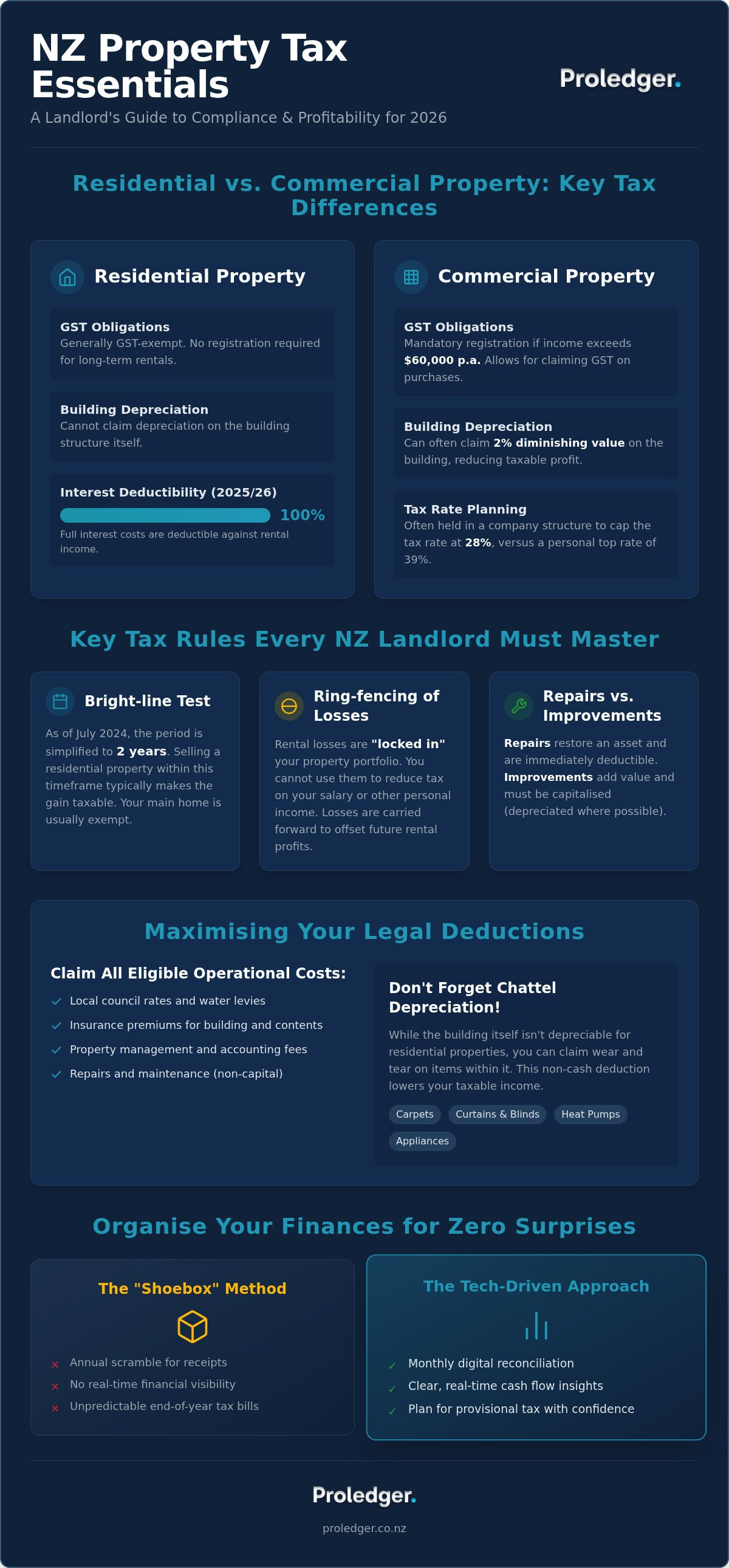
Choosing between residential and commercial property isn't just about the yield; it's about the underlying tax structure. While residential investing is the traditional path for many Kiwis, the tax on rental income NZ is handled quite differently across these two sectors. Residential property is largely treated as a "private" activity for GST purposes, whereas commercial property operates within the business tax net. This distinction influences everything from your daily cash flow to your long-term capital gains strategy.
One of the biggest wins for commercial investors is depreciation. Unlike residential properties, where you generally cannot claim depreciation on the building structure itself, commercial owners can often depreciate the building at a rate of 2% diminishing value. This provides a non-cash deduction that significantly reduces your taxable profit. Additionally, tenant types change the tax game. Residential tenancies are GST-exempt. Short-term stays like Airbnb or commercial leases, however, often trigger GST obligations that require a more structured approach to GST & Tax Filing.
Your personal marginal tax rate also plays a role. Rental profit is typically added to your other income and taxed at your personal rate, which could be as high as 39%. Commercial investors often use company structures to cap this at 28%, though this requires careful planning to manage the eventual distribution of funds.
The GST Factor in Commercial Property
If your commercial rental income exceeds $60,000 per annum, GST registration is mandatory. While this adds a layer of compliance, it offers a strategic advantage. You can often claim back the GST on the initial purchase price of the asset, which can inject significant capital back into your portfolio. It's a level of financial flexibility that residential landlords simply don't have, provided you manage the ongoing filing requirements accurately.
Residential Interest Deductibility in 2026
For the 2025/26 tax year, interest deductibility for residential rental properties has returned to 100% for all landlords. This marks a major shift from previous years when deductions were being phased out for existing housing stock. While "new builds" previously enjoyed specific exemptions, the current rules have levelled the playing field, allowing you to deduct the full interest cost of your mortgage against your rental income regardless of the property's age.
Key Tax Rules Every NZ Landlord Must Master
Staying ahead of the IRD requires more than just keeping receipts in a folder. The framework for tax on rental income NZ is designed to be rigorous; missing a single rule can turn a profitable year into a compliance headache. One of the most significant hurdles is ring-fencing. You can no longer use rental losses to offset your salary or other business income. These losses stay locked within your property portfolio, carrying forward to offset future rental profits or taxable gains from a property sale.
Distinguishing between repairs and capital improvements is another area where landlords often stumble. A repair restores an asset to its original condition and is usually deductible in the year it occurs. An improvement, however, adds value or extends the property's life, meaning it must be capitalised and depreciated where allowed. If your end-of-year tax bill exceeds $5,000, you'll likely trigger provisional tax. This requires you to pay your tax in instalments throughout the year, making Monthly Reconciliation essential for managing your cash flow effectively.
Maximising Legal Deductions
Effective tax management isn't just about paying what's due; it's about not paying a cent more than necessary. Ensure you are claiming all eligible operational costs:
- Local council rates and water levies.
- Insurance premiums for the building and contents.
- Professional fees for property management and accounting.
- Repairs and maintenance that don't qualify as capital works.
Don't overlook chattel depreciation. While you can't depreciate the house itself, you can claim the wear and tear on items like carpets, curtains, and heat pumps. This non-cash deduction lowers your taxable income without costing you a dollar in daily spending.
The Bright-line Rule in 2026
As of July 2024, the bright-line period has been simplified to two years for most properties. If you sell a residential property within two years of acquiring it, any gain is typically taxable. However, the main home exemption remains a vital safeguard for owners. The main home exemption ensures that your primary residence is protected from bright-line tax, provided you've used the property as your main home for most of the time you've owned it.
Organising Your Property Finances for Zero Surprises
The traditional end-of-year scramble to find faded receipts is the primary cause of tax-time stress for Kiwi investors. To truly master your tax on rental income NZ, you need to transition from annual "shoebox" accounting to a model of monthly reconciliation. This proactive approach gives you real-time visibility into your cash flow, ensuring you aren't blindsided by a large, unexpected IRD bill. Proledger provides this clarity through a fixed-fee structure, allowing landlords in Auckland, Christchurch, Nelson, and Richmond to budget for accounting costs just as they would for rates or insurance. It's about replacing reactive panic with methodical, tech-driven financial management.
AI-Enabled Bookkeeping for Landlords
Modern property management relies on speed and precision. By integrating automated platforms like Xero with Proledger's AI-enabled data analyst platform, you can eliminate manual data entry errors. This technology categorises your rental expenses in real time, flagging potential tax savings and providing instant financial insights. These insights are vital for making informed "buy or hold" decisions, as they show the actual performance of your portfolio after all tax obligations are considered. You no longer have to wait for your accountant to finish your annual return to know if your investment is genuinely profitable.
Choosing the Right Ownership Structure
The way you hold your property dictates your tax liability and asset protection. Personal ownership is straightforward but offers little flexibility for high-income earners. Look-through companies (LTCs) allow profits and losses to flow directly to shareholders while maintaining a corporate structure. Trusts provide robust asset protection but involve more complex compliance requirements. Selecting the right path early on is essential for long-term stability. Learn how we handle annual accounts for NZ SMEs and property investors to ensure every structure is optimised for maximum compliance, accurate tax on rental income NZ calculations, and zero year-end surprises.
Future-Proof Your Property Investment Strategy
Success in the New Zealand property market requires more than just picking the right postcode. It demands a sophisticated understanding of the structural differences between residential and commercial assets, from GST registration thresholds to building depreciation. Precision matters. By mastering these nuances and staying ahead of 2026 regulatory changes, you ensure your portfolio remains a source of wealth rather than a compliance burden. Managing your tax on rental income NZ shouldn't be a source of annual anxiety.
Transitioning to a tech-enabled, proactive accounting model allows you to focus on growth while we handle the data. Our team provides expert property tax advice for landlords in Auckland, Christchurch, and Nelson, ensuring every deduction is maximised and every filing is accurate. You can finally eliminate year-end accounting bill surprises with our fixed monthly fees. Take control of your financial clarity today and Get a Fixed-Fee Quote for Your Property Tax Compliance. Your path to a more profitable and predictable investment starts with the right partnership.
Frequently Asked Questions
Do I have to pay GST on residential rental income in NZ?
No, residential rental income is exempt from GST in New Zealand. You don't charge GST on rent, and you can't claim GST back on expenses like repairs or insurance. This differs from commercial property or short-term holiday stays, where GST registration becomes mandatory once your annual turnover exceeds $60,000.
What is the current bright-line period for property sold in 2026?
The bright-line period for properties sold in 2026 is two years. This rule applies to any residential property sold after 1 July 2024, regardless of when you originally purchased it. If you sell within this two-year window, any profit is added to your taxable income for that year, unless a specific exemption like the main home rule applies.
Can I claim the interest on my mortgage as a tax deduction?
Yes, you can claim 100% of your mortgage interest as a deduction for the 2025/26 tax year. The previous restrictions that phased out interest deductibility for existing residential properties have been removed. This change significantly impacts how you calculate tax on rental income NZ, as it allows you to offset the full cost of borrowing against your gross rent.
What happens if my rental property makes a loss?
Any financial loss your rental property makes is ring-fenced. This means you cannot use the loss to reduce the tax you pay on your salary or other business income. Instead, the loss is carried forward to future tax years to offset future rental profits or taxable gains from the eventual sale of the property.
Do I need a separate bank account for my rental property income?
While not a legal requirement for individual landlords, having a dedicated bank account is a best practice for clean bookkeeping. It creates a clear audit trail and makes monthly reconciliations much faster. Separating your personal spending from property expenses prevents errors and ensures you don't miss out on valid tax deductions when filing your annual accounts.
How does the IRD define a "repair" versus a "capital improvement"?
A repair restores an asset to its original condition without changing its character, such as fixing a broken window or painting a room. A capital improvement adds significant value, extends the property's life, or changes its use, like adding an extra bedroom. Repairs are immediately deductible, while improvements must be capitalised and potentially depreciated if they are chattels.
Disclaimer
The information in this article is general in nature and has been prepared for informational purposes only. It does not constitute accounting, tax, financial, or legal advice, and should not be relied upon as such.
While Proledger Consulting Limited takes care to ensure accuracy at the time of publication, laws, rates, and regulations (including NZ tax and employment law) change regularly, and this content may not reflect the most current position.
Before acting on any information in this article, we recommend you seek advice tailored to your specific circumstances. Contact us at proledger.co.nz or speak with a qualified professional. Proledger Consulting Limited accepts no liability for any loss or damage arising from reliance on this content.
© Proledger Consulting Limited. All rights reserved.
Frequently Asked Questions
Related articles



Book a Free Consultation
Chat with Proledger about your accounting, GST, or bookkeeping needs — no obligation.
Book a Free ConsultationMeet Our Experts