

Back-Office Accounting
Excellence
FBT Filing New Zealand: The 2026 SME Guide to Getting it Sorted

For many SME owners in New Zealand, Fringe Benefit Tax (FBT) feels like one of the more complex parts of the tax system. You want to reward your team with valuable perks, but the moment a company car is taken home for the weekend or you offer subsidised health insurance, you enter a world of specific rules and calculations. Getting it wrong can lead to overpaying the IRD or, worse, facing penalties for non-compliance. But getting it right isn't just about avoiding trouble; it's about strategically managing costs while building a great company culture.
This guide is designed to demystify FBT filing in New Zealand for 2026. We will break down what FBT is, how to calculate it without overpaying, and how modern, fixed-fee accounting services can remove the compliance burden entirely, letting you focus on growing your business.
Table of Contents
What exactly is Fringe Benefit Tax (FBT) in New Zealand?
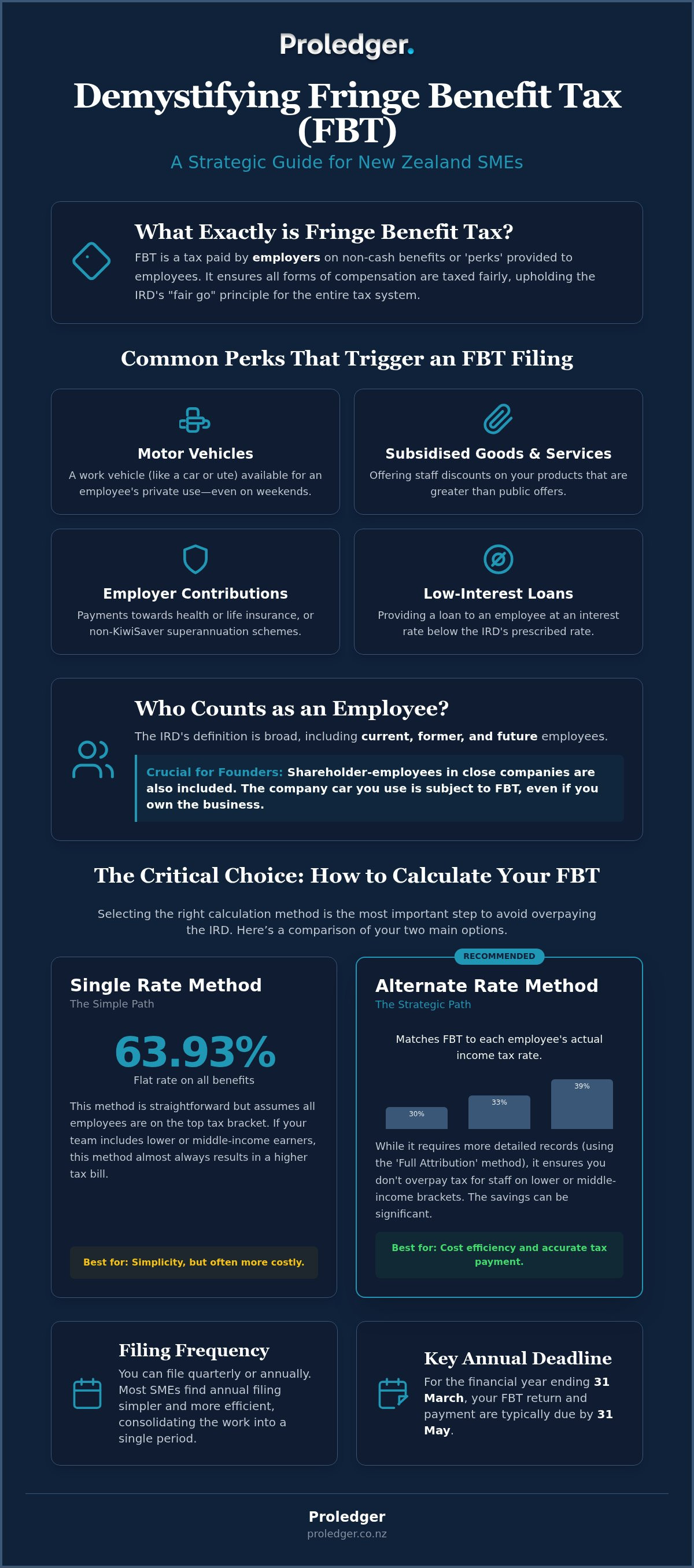
At its core, Fringe Benefit Tax (FBT) is a tax paid by employers on certain non-cash benefits provided to their employees. Think of it as the tax on the "perks" of the job. These benefits are considered part of an employee's total compensation package, even though they are not paid out as cash in their regular salary.
- Definition: FBT is a tax employers pay on non-cash benefits provided to employees or their associates (like a spouse or child).
- Common examples: The most frequent examples include work vehicles available for private use, subsidised gym memberships, low-interest loans, and employer contributions to health insurance schemes.
- Why it exists: The Inland Revenue Department (IRD) introduced FBT to ensure that all forms of employee compensation are taxed fairly. Without it, businesses could pay employees a small salary and provide the rest of their compensation as tax-free perks, creating an imbalance in the tax system.
- The "Fair Go" principle: In essence, FBT ensures the IRD gets its share of the value from these perks, maintaining fairness and integrity across the entire tax framework.
Common perks that trigger an FBT filing
While the list of potential fringe benefits is long, a few common examples account for most FBT obligations for New Zealand SMEs. Recognising these triggers is the first step towards compliant FBT filing.
- Motor vehicles: This is the number one trigger for FBT. If an employee can use a work vehicle for private purposes—even just taking the ute home over the weekend or using the company car for school drop-offs—it is generally considered a fringe benefit.
- Subsidised goods and services: Offering your staff significant discounts on the products or services your business sells can attract FBT. This applies when the discount is greater than what you would offer to the general public.
- Employer contributions: Payments towards certain insurance policies (like health or life insurance) or contributions to non-KiwiSaver superannuation schemes are often liable for FBT. Note that employer contributions to an employee's KiwiSaver account are subject to Employer Superannuation Contribution Tax (ESCT), not FBT.
- Low-interest loans: If you provide a loan to an employee at an interest rate below the IRD's prescribed rate, the interest saving is considered a fringe benefit.
Who counts as an employee for FBT?
The IRD’s definition of an "employee" for FBT purposes is broader than you might think. It is crucial to understand who is covered to ensure you are meeting your obligations.
- The definition includes current, former, and even future employees who have been promised a benefit as part of their employment agreement.
- Crucially for many small businesses, shareholder-employees in close companies are also included. Many founders are surprised to learn that the company car they use is subject to FBT, even though they own the business.
How to handle FBT filing and avoid common stuff-ups
A methodical approach to FBT filing can save you time, money, and stress. By breaking it down into a clear process, you can ensure accuracy and avoid the common pitfalls that lead to IRD audits or overpayments. Here is a simple four-step framework to follow.
- Identify all non-cash benefits: Systematically review your accounts and payroll for the period to identify every potential fringe benefit provided to your team, whether they are based in Richmond, Auckland, or working remotely. This includes everything from vehicle use to discounted goods.
- Determine the taxable value: Once you have identified the benefits, you need to calculate their taxable value according to IRD rules. For vehicles, this might be based on the vehicle's cost price or book value. For other benefits, it is often based on what the employee would have paid on the open market.
- Choose your calculation method: This is a critical step where many businesses inadvertently overpay. You have choices in how you calculate the FBT owed, and selecting the most appropriate method for your business structure and employee base can significantly reduce your tax bill.
- File your return and pay on time: The final step is to file your FBT return (quarterly or annually) through myIR and make the payment by the due date. Missing deadlines can result in late filing penalties and interest charges. For annual filers, the key date to remember is the end of the financial year on March 31st, with the return and payment typically due by May 31st.
Choosing the right calculation method
The IRD provides different methods for calculating FBT, and your choice can have a major impact on your final tax bill. While one method might be simpler, another could be far more cost-effective.
- Single rate vs. alternate rate: You can use a flat single rate of 63.93% on the taxable value of all benefits. While simple, this assumes all employees are on the top tax bracket. The alternate rate calculation allows you to use rates that correspond to each employee's marginal income tax rate, which can be much lower.
- The "Short Form" vs. "Full Attribution" method: These are two ways to apply the alternate rate. The full attribution method, while requiring more detailed records, often results in a lower FBT liability for staff on lower or middle-income brackets. This is because you are taxing the benefit at a rate that more accurately reflects the employee's actual tax position, rather than a high flat rate.
Filing frequencies: Quarterly vs. Annual
You can choose to file your FBT returns either every quarter or once a year. The best option depends on the size of your business and your administrative capacity.
- Annual filing: Most small businesses prefer to file annually. This consolidates the administration into a single period, which can be more efficient if you only provide a few, consistent benefits. The return covers the financial year ending March 31st.
- Quarterly filing: Businesses with a larger number of employees or more complex benefits may opt for quarterly filing. This can improve cash flow management by spreading the tax payments throughout the year instead of facing a single large bill. This is a common strategy for growing teams in hubs like Christchurch or Nelson.
Why SMEs are moving to fixed-fee FBT management
As your business grows, so does the complexity of tax compliance. The time spent manually tracking vehicle logbooks, calculating benefit values, and navigating myIR is time that could be spent on strategy, sales, or innovation. This is why a growing number of New Zealand SMEs are shifting to professional, fixed-fee FBT management services.
- No more surprise accounting bills: A fixed-fee model means you know exactly what your compliance costs are each month or year. This budgetary certainty eliminates the fear of receiving a large, unexpected bill after your return is filed.
- AI-enabled accuracy: Modern accounting partners use sophisticated platforms to automatically scan transactions and categorise expenses, flagging potential fringe benefits that might otherwise be missed. This technology-driven approach minimises manual errors and ensures a more accurate FBT return.
- Proactive strategic advice: A true partner does more than just file your taxes. They provide proactive advice, helping you understand the FBT implications of a new perk before you offer it. This allows you to structure employee benefits in the most tax-efficient way possible.
- Local expertise: Tax legislation is nuanced. Having a dedicated team that understands the specific challenges of the New Zealand tax landscape, from Auckland to Richmond, ensures your FBT filing is not only compliant but also optimised for your business.
The Proledger approach to FBT compliance
At Proledger, we treat FBT filing not as an isolated chore but as an integrated part of your overall financial health. Our approach is built on technology, expertise, and a commitment to proactive partnership.
- We integrate FBT filing directly into your regular GST and tax compliance workflow, creating a seamless and efficient process.
- Our advanced AI tools help identify potential fringe benefits in your general ledger that you might have overlooked, ensuring nothing falls through the cracks.
- Learn how our comprehensive bookkeeping and payroll services create a foundation of clean, accurate records, making FBT and other IRD filings straightforward and stress-free.
Saving time with automated back-office support
Your time as a business owner is your most valuable asset. Delegating the complex and time-consuming tasks of tax compliance frees you up to focus on what you do best: driving your business forward.
- Delegate the stress of deadlines and calculations to professionals who live and breathe New Zealand tax law.
- Focus on your core business goals, confident that your back-office financial operations and IRD filings are being managed with precision and care.
Frequently Asked Questions (FAQs)
Do I have to pay FBT on a company car if it is only used for work?
Generally, if a work vehicle is not available for an employee's private use, it is not subject to FBT. However, the IRD has strict rules. For example, a "work-related vehicle" must typically have the company logo permanently displayed, and private use must be restricted to minimal travel between home and work. If the vehicle is available for any other private use (like running errands on the way home), it may trigger FBT.
How much is the FBT rate in New Zealand for 2026?
There isn't a single FBT rate. Employers can choose to use a flat rate of 63.93% on all benefits. Alternatively, they can use the "alternate rate" calculation, which involves applying different rates (e.g., 11.73%, 21.21%, 42.86%, or 63.93%) based on the cash remuneration of each employee. Choosing the right method is key to avoiding overpayment.
What is the de minimis rule for FBT, and how does it help small businesses?
The de minimis rule allows employers to provide small, unclassified benefits without having to pay FBT. For an employer who files FBT returns quarterly, the exemption limit is $300 per employee per quarter, with a total limit of $22,500 for all employees per year. This is useful for small, infrequent perks like staff gifts or occasional team shouts, simplifying compliance for minor benefits.
Can I claim GST on the fringe benefits I provide to my staff?
Yes, in most cases, you can claim the GST portion you paid on the goods or services provided as fringe benefits. When you calculate your FBT, you will also need to make a corresponding GST adjustment on your GST return to account for the private use portion of the benefit.
Disclaimer
The information in this article is general in nature and has been prepared for informational purposes only. It does not constitute accounting, tax, financial, or legal advice, and should not be relied upon as such.
While Proledger Consulting Limited takes care to ensure accuracy at the time of publication, laws, rates, and regulations (including NZ tax and employment law) change regularly, and this content may not reflect the most current position.
Before acting on any information in this article, we recommend you seek advice tailored to your specific circumstances. Contact us at proledger.co.nz or speak with a qualified professional. Proledger Consulting Limited accepts no liability for any loss or damage arising from reliance on this content.
© Proledger Consulting Limited. All rights reserved.
Frequently Asked Questions
Related articles



Book a Free Consultation
Chat with Proledger about your accounting, GST, or bookkeeping needs — no obligation.
Book a Free ConsultationMeet Our Experts