

Back-Office Accounting
Excellence
ERP for Small Business NZ: Case Study Growth Framework
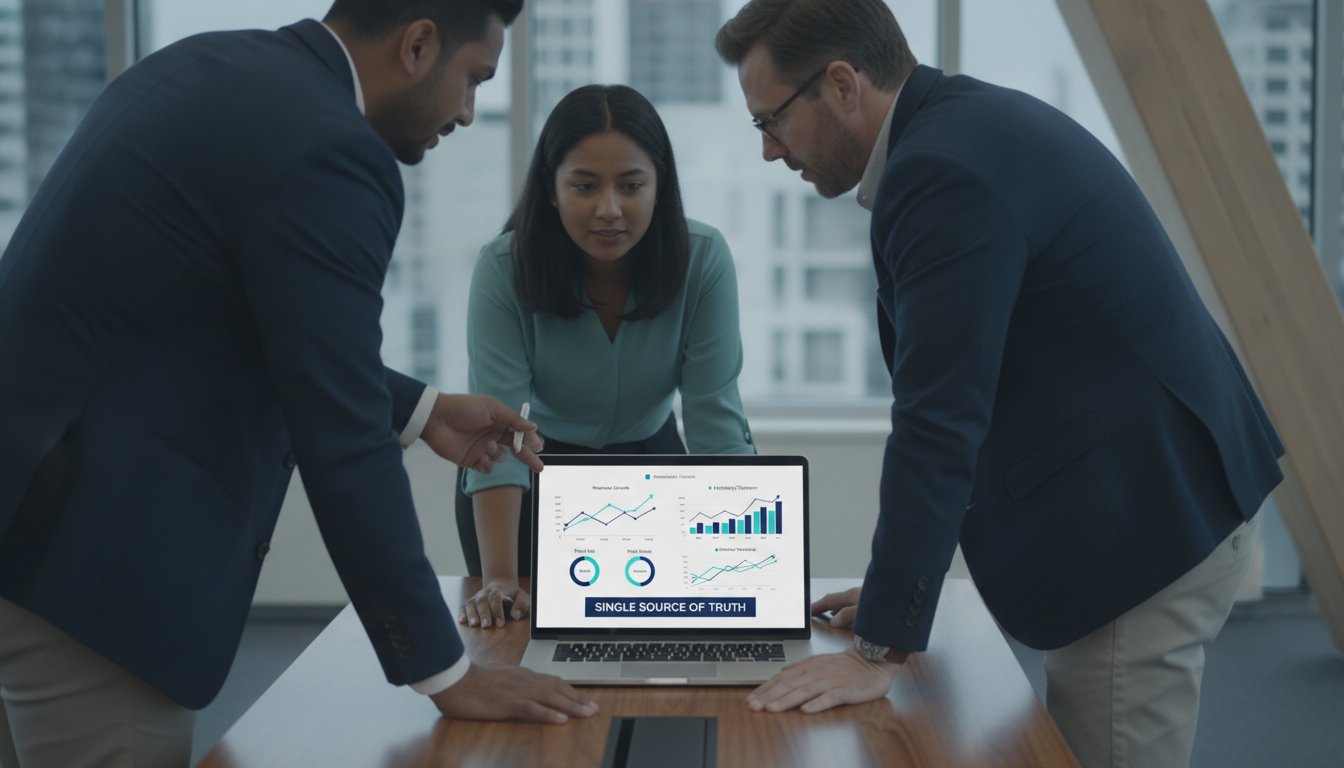
For many New Zealand small business owners, growth feels like a double-edged sword. The excitement of scaling is often tempered by the operational chaos that follows. Systems that once worked perfectly, like basic accounting software, start to buckle under the pressure of increased complexity. Manual data entry, disconnected apps, and delayed financial reports become the norm, creating a "messy middle" that stifles progress.
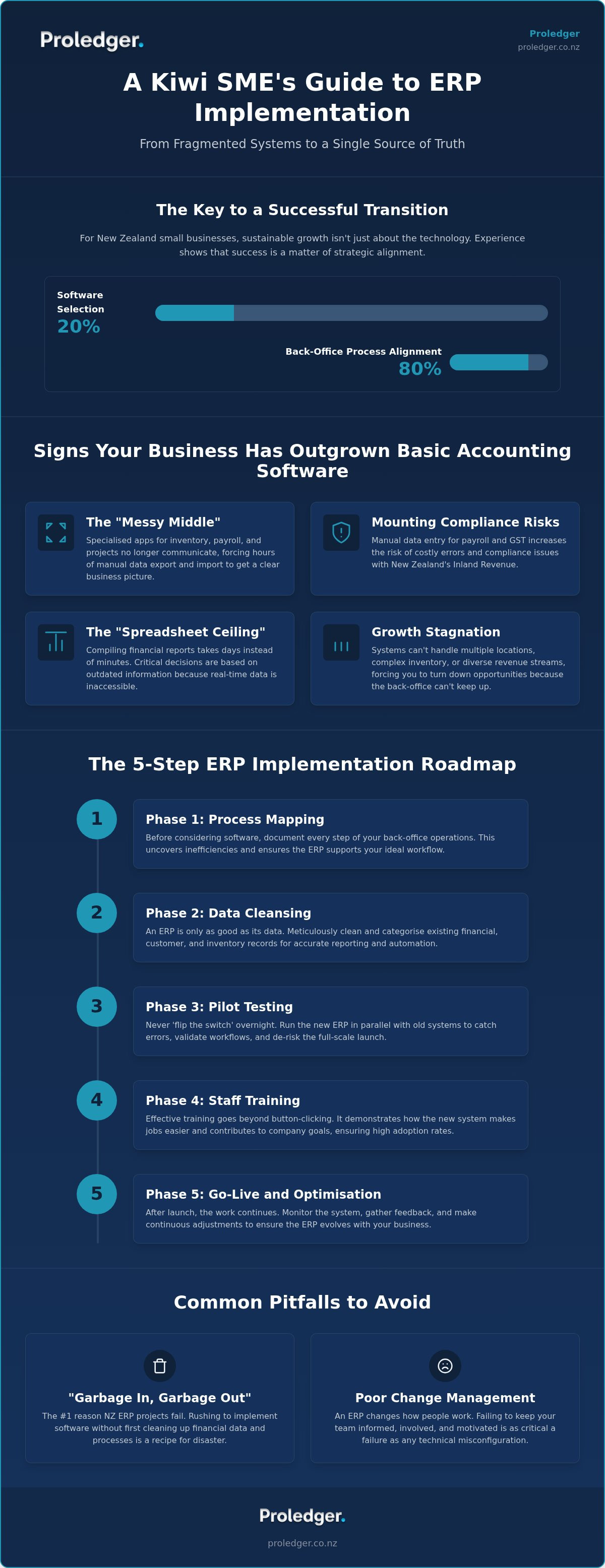
The solution isn't another spreadsheet or a temporary software patch. It's a strategic shift from reactive bookkeeping to proactive resource planning. A successful Enterprise Resource Planning (ERP) implementation for your small business in NZ is the key to unlocking sustainable growth, but it requires a clear framework. In our experience, success is 20% software selection and 80% aligning your back-office processes.
This guide provides a case study-driven framework for Kiwi SMEs, showing you how to transition from fragmented systems to a single source of truth without the typical implementation headaches.
Table of Contents
Signs Your NZ Small Business Has Outgrown Basic Accounting Software
The tipping point often arrives without warning. One day, your trusted accounting software is your best asset; the next, it’s the bottleneck holding your business back. This is a common challenge we see with fast-growing SMEs. Recognising the signs early is crucial for a smooth transition to a more robust system.
- The "Messy Middle": Your collection of specialised add-ons for inventory, payroll, and project management no longer communicate efficiently with your core accounting software like Xero. Staff spend hours manually exporting and importing data just to get a clear picture of the business.
- Mounting Compliance Risks: As your team grows, the risk of manual errors in payroll and GST filing increases. A single incorrect data entry can lead to compliance issues with the New Zealand Inland Revenue, creating costly and time-consuming problems.
- Hitting the "Spreadsheet Ceiling": Your profit and loss statement, once a quick report, now takes days or even weeks to compile from multiple spreadsheets. You're making critical business decisions based on outdated information because real-time data is impossible to access.
- Growth Stagnation: We often see Auckland and Christchurch startups hit this wall during their second or third year. Their systems can't handle multiple locations, complex inventory, or diverse revenue streams, forcing them to turn down opportunities because their back-office can't keep up.
The Cost of Fragmented Systems in the NZ Market
The issues with outdated systems go beyond simple frustration; they have a direct financial impact. When your inventory management platform is disconnected from your accounting ledger, you can miss out on claiming GST on all eligible expenses, leading to overpayment. More significantly, there's the hidden labour cost. Every hour your team spends manually reconciling data between platforms is an hour not spent on sales, customer service, or innovation. This operational drag is a silent profit killer for many Kiwi businesses.
Moving Beyond Simple Bookkeeping
A standard ledger is perfect for tracking money in and money out. But for a business managing stock across multiple warehouses or offering complex services, it’s not enough. The goal is to move from reactive accounting—looking at what happened last month—to proactive resource planning. An ERP system provides a unified view of your entire operation, from finance and HR to supply chain and customer relations. This allows you to anticipate future needs, optimise cash flow, and make strategic decisions based on a complete, real-time dataset.
The 5-Step ERP Implementation Roadmap for Kiwi SMEs
Moving to an ERP can feel like a monumental task, but a structured approach demystifies the process. This five-step roadmap is designed specifically for the realities of a small business in NZ, focusing on clarity, risk mitigation, and long-term success.
- Phase 1: Process Mapping
Before you even look at software, you must document how your business actually operates. This means mapping every step of your back-office functions, from how an order is processed to how payroll is run. This foundational step uncovers inefficiencies and ensures your new ERP is configured to support your ideal workflow, not force you into a generic one. - Phase 2: Data Cleansing
An ERP is only as good as the data you put into it. Migrating years of messy, inconsistent, or incomplete data will guarantee failure. This phase involves meticulously cleaning and categorising your existing financial records, customer lists, and inventory data. A clean dataset is non-negotiable for accurate reporting and reliable automation. - Phase 3: Pilot Testing
Never "flip the switch" overnight. The safest approach is to run your new ERP in parallel with your old systems for a short period. This pilot phase allows you to compare outputs, catch configuration errors, and validate the new workflows in a low-risk environment before committing the entire business to the new platform. - Phase 4: Staff Training
A powerful tool is useless if your team doesn't know how to use it. Effective training is about more than just showing people which buttons to click. It’s about demonstrating how the ERP makes their jobs easier and contributes to the company's goals. Whether your team is in Nelson or working remotely, tailored training ensures high adoption rates and a positive return on investment. - Phase 5: Go-Live and Optimisation
With processes mapped, data cleaned, and staff trained, you're ready for the official launch. But the work doesn't stop here. The first few months are about monitoring the system, gathering feedback from your team, and making small adjustments to optimise performance and ensure the ERP evolves with your business.
Avoiding the Common Implementation Pitfalls
The phrase "garbage in, garbage out" is the number one reason most NZ ERP projects fail. A rush to implement software without first cleaning up financial data and processes is a recipe for disaster. The second major pitfall is poor change management. An ERP changes how people work, and resistance is natural. Keeping your team informed, involved, and motivated throughout the transition is just as important as the technical configuration. Transparent communication and highlighting the benefits for each team member are key to a smooth rollout.
Local Compliance and GST Integration
An ERP must be configured for New Zealand's specific regulatory environment. This includes setting up correct GST rates, managing Fringe Benefit Tax (FBT) requirements, and ensuring payroll complies with local employment laws. A well-configured ERP can automate your GST return preparation by pulling all relevant sales and expense data into a single report, drastically reducing manual effort and the risk of errors.
Maximising ROI: Integrating ERP with Proledger’s Fixed-Fee Support
Software alone doesn't solve business problems; a strategic partnership does. An ERP implementation is not just a technical project but a fundamental business transformation. Proledger’s approach combines expert implementation with ongoing financial management to ensure you get the maximum return on your investment.
- Predictable Costs: Our monthly fixed-fee model eliminates the fear of spiralling implementation and support costs. You get a clear, predictable monthly bill for implementation, bookkeeping, and advisory, allowing for better budgeting and financial planning.
- AI-Powered Insights: An ERP generates vast amounts of data. Our AI finance automation platform sits on top of your ERP, turning that raw data into instant, actionable answers. Ask complex questions about your business in plain English and get immediate insights.
- Expert Guidance: Real-time reports are only useful if you know how to interpret them. Our business advisory services help you understand the story your data is telling, guiding you toward more profitable strategic decisions.
- A Solid Foundation: A successful ERP relies on pristine financial data. Our outsourced payroll and bookkeeping services provide the perfect foundation, ensuring the information flowing into your new system is accurate and compliant from day one.
Ready to build a scalable back-office for your growing business? Book a consultation to discuss your ERP implementation strategy with Proledger.
Real-Time Insights and AI Automation
Standard financial reports show you what happened. Our AI-enabled platform shows you why it happened and what is likely to happen next. By analysing data from your ERP, it can identify subtle cash flow management trends, pinpoint your most profitable customers, or flag potential inventory shortages before they become a problem. This gives you a significant competitive advantage, allowing you to be proactive rather than reactive.
Your Strategic Ally for Long-Term Growth
The end of an ERP implementation is just the beginning of our partnership. We move seamlessly from project management to providing ongoing support with management accounts, tax compliance, and strategic planning. We ensure your ERP remains a powerful tool for growth, not a technical burden. With Proledger, you gain more than a service provider; you gain a strategic ally dedicated to your long-term success.
Frequently Asked Questions
How much does ERP implementation cost for a small business in NZ?
Costs vary widely based on business complexity, the number of users, and the level of customisation required. However, the biggest cost is often disruption and failure. Proledger's fixed-fee model for implementation and ongoing support makes costs predictable and helps you avoid the hidden expenses that plague typical IT projects.
How long does it take to set up an ERP system for a Kiwi SME?
A typical implementation for a small to medium-sized business can take anywhere from three to nine months. Our phased roadmap is designed to ensure a steady, manageable pace that minimises disruption to your daily operations.
Do I need to replace Xero to use an ERP system?
Not necessarily. Some modern ERPs can integrate with Xero, using it as the core accounting ledger while the ERP handles more complex operational areas like inventory or manufacturing. For other businesses, a full suite ERP that includes a robust financial module is a more streamlined solution. We help you determine the right strategy for your specific needs.
Can an ERP help with my NZ payroll and GST compliance?
Absolutely. A properly configured ERP automates GST tracking on both sales and purchases, simplifying your filing process with the Inland Revenue. Integrated payroll modules ensure accurate calculations, leave entitlement tracking, and compliance with all New Zealand employment regulations, saving you significant time and reducing risk.
Disclaimer
The information in this article is general in nature and has been prepared for informational purposes only. It does not constitute accounting, tax, financial, or legal advice, and should not be relied upon as such.
While Proledger Consulting Limited takes care to ensure accuracy at the time of publication, laws, rates, and regulations (including NZ tax and employment law) change regularly, and this content may not reflect the most current position.
Before acting on any information in this article, we recommend you seek advice tailored to your specific circumstances. Contact us at proledger.co.nz or speak with a qualified professional. Proledger Consulting Limited accepts no liability for any loss or damage arising from reliance on this content.
© Proledger Consulting Limited. All rights reserved.
Frequently Asked Questions
Related articles



Book a Free Consultation
Chat with Proledger about your accounting, GST, or bookkeeping needs — no obligation.
Book a Free ConsultationMeet Our Experts