

Back-Office Accounting
Excellence
GST Filing NZ: The Ultimate Guide to Stress-Free Compliance in 2026

What if your GST return was a strategic health check for your cash flow rather than a source of looming dread? For many New Zealand business owners, the two-monthly deadline feels like a race against the clock. You likely spend hours wrestling with manual data entry or worrying if a simple mistake will trigger an IRD audit. It is exhausting to feel uncertain about which expenses are truly deductible, especially with the recent May 2026 rule changes regarding pre-registration claims for goods valued under NZ$10,000.
We understand that you want to focus on growing your business, not decoding tax legislation. This guide empowers you to master GST filing NZ by providing a clear roadmap from calculation to lodgement. You will discover how to avoid common penalties, maximise your refunds, and implement modern systems that streamline your compliance. We will walk you through the essential 2026 requirements and show you how to transform this administrative burden into a fast, automated process that protects your bottom line and ensures total peace of mind.
Key Takeaways
- Understand the NZ$60,000 registration threshold and the strategic advantages of voluntary registration for your growing business.
- Master the step-by-step process of GST filing NZ, from collecting digital records to accurately calculating output tax for the IRD.
- Avoid expensive interest and late penalties by staying ahead of the 2026 filing deadlines and recent changes to input tax deduction rules.
- Transform your GST return into a powerful cash flow tool that provides clear visibility into your operational performance and financial health.
- Learn how modern automation eliminates manual data entry, ensuring your compliance is both precise and significantly more time-efficient.
Table of Contents
The Essentials of GST Filing in New Zealand
Understanding the fundamentals of GST filing NZ is the first step toward financial clarity. At its core, Goods and Services Tax is a 15% charge added to most products and services. While businesses collect this on behalf of the government, they also gain the right to claim back GST paid on business-related expenses. This circular flow makes New Zealand's GST system one of the most efficient in the world, yet it requires precise management to avoid cash flow bottlenecks.
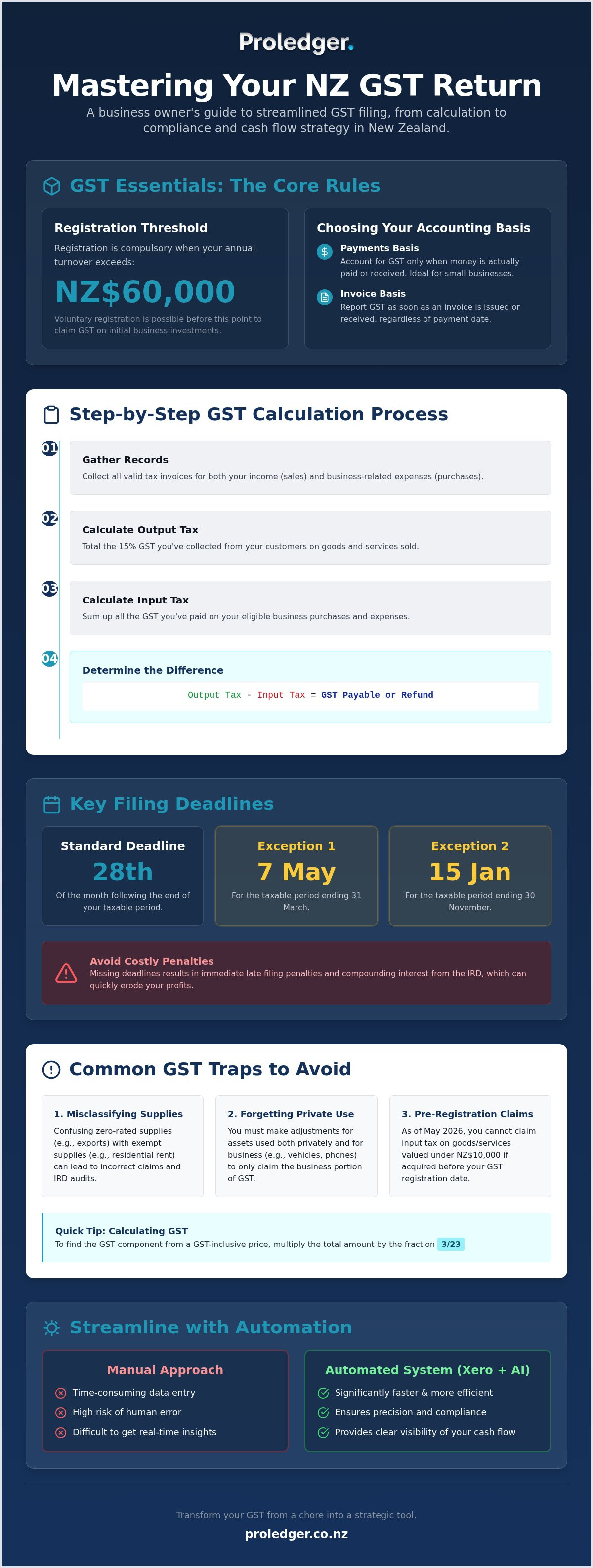
Registration becomes compulsory once your annual turnover exceeds NZ$60,000. However, many startups choose to register voluntarily before hitting this mark. Doing so allows you to recover GST on significant initial investments. Be aware of the May 2026 clarification: you cannot claim input tax deductions for goods or services valued at NZ$10,000 or less if they were acquired before your registration date. This makes the timing of your registration a critical strategic decision. You must also choose an accounting basis. The 'Payments basis' is often preferred by small businesses because you only account for GST when money actually changes hands. In contrast, the 'Invoice basis' requires you to report GST as soon as an invoice is issued. Understanding these technicalities makes GST filing NZ far more manageable for busy directors.
Who Needs to File GST?
If you carry out a 'taxable activity'-any regular activity performed for a consideration or profit-you likely fall within the GST net. This applies to both sole traders and companies. It is vital to distinguish between taxable and exempt supplies. For example, residential rent and most financial services are exempt. This means you don't charge GST on these services, but you also cannot claim GST back on related expenses. Getting this wrong often leads to unintended IRD scrutiny.
GST Deadlines and Penalties
Consistency is your best defence against the IRD. Most returns are due by the 28th of the month following your taxable period. You must remember two key exceptions. The return for the period ending 31 March is due on 7 May, while the period ending 30 November is due on 15 January. Missing these dates is a costly mistake. The IRD applies immediate late filing penalties and compounding interest that quickly erodes your profit margins. We recommend aligning your filing frequency with your business scale. While two-monthly is the standard, businesses with turnover under NZ$500,000 can opt for six-monthly filing to reduce administrative pressure.
Step-by-Step: How to Calculate and Lodge Your GST Return
Precision is the backbone of successful tax management. You begin the process by gathering all valid tax invoices for both your income and your business expenses. To find your final figure, calculate your output tax by totalling the GST collected from customers, then determine your input tax by summing the GST paid on business purchases. The difference between these two figures determines whether you owe the crown or are due a refund. The final lodgement is completed electronically via Inland Revenue's official GST information portal, myIR, which is the mandatory method for all modern businesses.
Common GST Calculation Traps
Errors often occur when distinguishing between zero-rated supplies, such as exported goods, and exempt supplies like residential rent. Misclassifying these can result in significant overpayments or compliance gaps that trigger audits. You must also account for private use adjustments if an expense, such as a mobile phone or vehicle, is not used exclusively for business purposes. To calculate the tax component from a GST-inclusive price, multiply the total by the GST fraction of 3/23.
Streamlining the Process with Xero and AI
Transitioning from manual spreadsheets to cloud-based systems like Xero significantly reduces the risk of human error. These platforms automate bank feeds and speed up the reconciliation of your GST filing NZ. We take this a step further by ensuring Proledger integrates AI Finance Automation to provide an extra layer of oversight. This technology identifies missing documentation or tax code mismatches before you submit your return. It is a proactive way to maintain accuracy and ensure you are claiming every dollar you are entitled to. If you are ready to reclaim your time, you might discover our AI-driven bookkeeping services to streamline your entire financial workflow.
Beyond DIY: Why Proactive GST Management Saves Your Business Money
Your GST return is more than a compliance obligation. It is a real-time diagnostic tool for your business health. High output tax figures indicate strong sales; yet they can mask underlying cash flow issues if your debtors aren't paying on time. We recommend moving away from the stressful year-end rush. Monthly reconciliation ensures your records are always current, allowing you to make informed decisions based on accurate data rather than outdated estimates. This shift in perspective transforms GST filing NZ from a tax burden into a strategic advantage.
Avoid the common "GST Surprise" by maintaining a dedicated tax account. It is non-negotiable to set aside the 15% you collect from every invoice immediately. This proactive habit ensures the funds are ready when the 28th of the month arrives, protecting your operational capital. Proledger serves as the strategic bridge for businesses in Auckland and Christchurch, providing the infrastructure needed for sustainable growth. Our fixed-fee structure means you get expert oversight without the fear of unpredictable hourly billing or surprise invoices at the end of the quarter.
The Benefits of Outsourcing GST Filing
Delegating your tax requirements reduces your audit risk through professional review and IRD-approved lodgement. Business owners in Nelson or Richmond often find they reclaim over 10 hours a month by stepping away from manual data entry. This time is better spent on core operations or business development. You can explore our fixed-fee bookkeeping and GST services to see how we handle the technical details while you focus on your passion.
Preparing for an IRD Audit
Compliance requires discipline and meticulous record-keeping. You must retain all business records, including tax invoices and bank statements, for at least seven years. Having a registered tax agent like Proledger changes the audit experience entirely. We act as your primary point of contact with the IRD, ensuring all requested information is precise, complete, and professionally presented. This partnership provides a layer of security that "do-it-yourself" GST filing NZ simply cannot match, giving you total peace of mind in your financial standing.
Secure Your Financial Future with Confidence
Handling GST filing NZ successfully requires a shift from reactive panic to proactive management. You now understand that accurate record-keeping and the NZ$60,000 threshold are only the beginning of your compliance journey. By implementing automated bank feeds and leveraging AI oversight, you can eliminate the manual errors that lead to compounding IRD interest. These modern tools ensure your returns are precise, repeatable, and significantly faster to lodge than traditional manual methods.
Professional support is the ultimate safeguard for your business stability. Proledger provides the certainty of predictable monthly costs and the expertise of local specialists in Auckland and Christchurch. Our AI-enabled platforms offer instant financial insights, ensuring you never face a "GST surprise" again. It's time to delegate the administrative burden so you can focus on building your legacy and pursuing your passions. Get a Fixed-Fee GST Filing Quote from Proledger today. You've built a great business; let's ensure its financial foundation is just as strong.
Frequently Asked Questions
Do I have to register for GST if my turnover is under NZ$60,000?
Registration is voluntary if your annual turnover is below the NZ$60,000 threshold. You're only legally required to register if your turnover has exceeded this limit in the last 12 months or is expected to do so in the next 30 days. Many small businesses choose to register voluntarily to claim back GST on significant startup costs, though this also means you must add 15% to your prices and file regular returns.
Can I claim GST on expenses if I am not registered yet?
You generally cannot claim GST on business expenses incurred before your official registration date. Special rules apply to assets you already own at the time of registration, but these have become stricter recently. From 22 May 2026, the IRD clarified that input tax deductions are unavailable for goods and services valued at NZ$10,000 or less if they were acquired before you registered for GST filing NZ. Always verify the status of high-value assets with a professional before making a claim.
What happens if I make a mistake on a filed GST return?
You can correct most errors through the myIR portal or by making a voluntary disclosure to the Inland Revenue. If the mistake is minor and the tax effect is small, you might be able to include the adjustment in your next return. It's best to fix underpayments quickly to avoid compounding interest charges. Having a clear audit trail in your accounting software makes these corrections straightforward and helps maintain a positive relationship with the IRD.
How long does it take to get a GST refund from the IRD?
The IRD typically processes GST refunds within 15 working days of receiving your return. If your return is selected for a routine check or if you've claimed an unusually large refund, the process may take longer while they verify your documentation. Ensuring your GST filing NZ is accurate and supported by digital invoices helps prevent these delays. Clean data and proactive reconciliation are the best ways to ensure your refund hits your bank account without unnecessary administrative hold-ups.
Disclaimer
The information in this article is general in nature and has been prepared for informational purposes only. It does not constitute accounting, tax, financial, or legal advice, and should not be relied upon as such.
While Proledger Consulting Limited takes care to ensure accuracy at the time of publication, laws, rates, and regulations (including NZ tax and employment law) change regularly, and this content may not reflect the most current position.
Before acting on any information in this article, we recommend you seek advice tailored to your specific circumstances. Contact us at proledger.co.nz or speak with a qualified professional. Proledger Consulting Limited accepts no liability for any loss or damage arising from reliance on this content.
© Proledger Consulting Limited. All rights reserved.
Frequently Asked Questions
Related articles



Book a Free Consultation
Chat with Proledger about your accounting, GST, or bookkeeping needs — no obligation.
Book a Free ConsultationMeet Our Experts