

Back-Office Accounting
Excellence
ERP Implementation for NZ SMEs: 2026 Buying Guide

Your New Zealand business is growing. What was once a manageable flow of invoices and orders has become a torrent of disconnected data. Your team is stuck in a cycle of manual reconciliations, wrestling with spreadsheets that are no longer fit for purpose. You’ve hit the “admin wall,” and the basic accounting software that got you here won’t get you to the next level.
This is the critical point where many Kiwi SMEs start considering an Enterprise Resource Planning (ERP) system. But the path is littered with stories of costly, failed implementations. The fear of choosing the wrong software, disrupting operations, and facing spiralling costs is real.
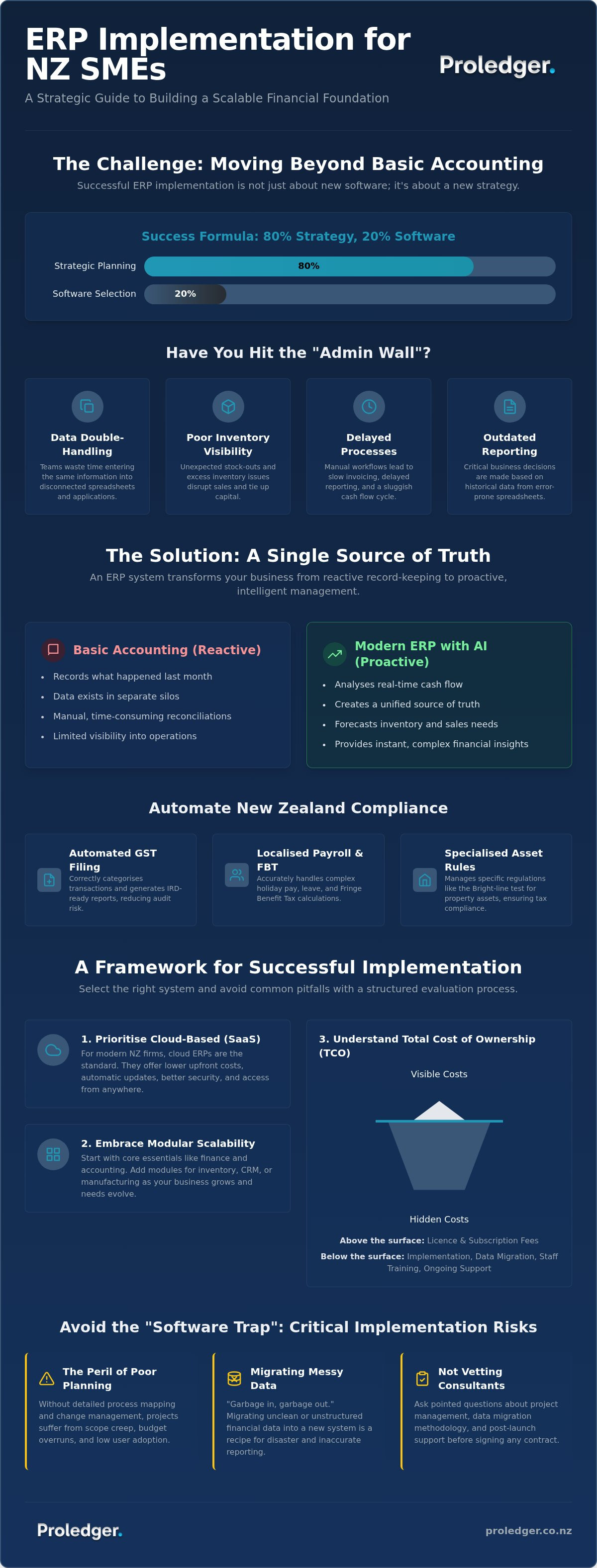
The secret? Successful ERP implementation for SMEs in NZ is 20% software selection and 80% strategic planning. It’s about building a scalable financial foundation that aligns with local compliance and delivers powerful, AI-driven insights. This guide will show you how to navigate the process, avoid the common pitfalls, and create a single source of truth to drive your business forward.
Table of Contents
Beyond Basic Accounting: Why Your NZ SME Needs an ERP in 2026
For a growing Kiwi business, moving from Xero or MYOB to an ERP is like upgrading from a calculator to a supercomputer. It’s a fundamental shift from simply recording transactions to building an integrated system that manages every aspect of your operations—from inventory and sales to finance and human resources.
- Defining ERP for the Kiwi Context: An ERP system breaks down data silos. Instead of having separate apps for sales, stock, and finance, it creates a unified “single source of truth.” When a sales order is placed, inventory is automatically updated, and the financial ledger reflects the transaction in real-time.
- Identifying the "Admin Wall": You've hit the wall when your team spends more time double-handling data than serving customers. It shows up as stock-outs due to poor inventory visibility, delayed invoicing because of manual processes, and business decisions based on outdated spreadsheet reports. These aren't just annoyances; they are direct costs to your growth.
- Proactive Business Intelligence: Basic accounting is reactive; it tells you what happened last month. An ERP, supercharged with AI-enabled platforms, is proactive. It provides real-time cash flow analysis, forecasts inventory needs, and answers complex financial questions instantly, allowing you to make strategic decisions with confidence.
Integrating NZ Compliance: GST, FBT, and Payroll
A generic, off-the-shelf ERP system can quickly become a compliance nightmare in New Zealand. Our local tax and employment laws have unique complexities that your system must handle natively. A well-implemented, localised ERP turns these obligations from a burden into a streamlined, automated process.
- Automated Tax Filing: A properly configured ERP can automate most of the GST filing process for your NZ business. It correctly categorises transactions, calculates liabilities, and generates reports ready for the IRD, significantly reducing audit risks and administrative overhead.
- Localised Payroll and FBT: Calculating holiday pay, managing leave entitlements, and assessing Fringe Benefit Tax (FBT) are notoriously complex in New Zealand. An ERP with localised modules ensures these calculations are performed accurately and consistently, saving you from costly payroll errors.
- Specialised Asset Management: For SMEs involved in property, an ERP must be ableto handle the specific requirements of regulations like the Bright-line test, ensuring capital gains and losses are tracked correctly for tax purposes.
Selecting the Right ERP: A Framework for Kiwi Business Owners
The market is flooded with ERP options, from global giants like NetSuite to modular solutions like Odoo. Too often, business owners get fixated on software features and sales demos, losing sight of the bigger picture. The key is to use a structured framework to evaluate what your business truly needs, not just what a vendor wants to sell you.
A successful selection process is built on careful planning, not a rushed decision. It involves mapping your current workflows, identifying bottlenecks, and defining your future-state goals before you even look at a single piece of software.
- Cloud vs. On-Premise: For the vast majority of modern firms in Auckland, Christchurch, and across NZ, cloud-based (SaaS) ERPs are the standard. They offer lower upfront costs, automatic updates, better security, and the flexibility to access your business data from anywhere.
- Modular Scalability: Your business doesn't need every feature on day one. A modular ERP allows you to start with the core essentials—typically finance and accounting—and add other modules like inventory management, CRM, or manufacturing as your business matures and your needs evolve.
- Total Cost of Ownership (TCO): The sticker price is just the beginning. A true cost assessment must factor in subscription fees, one-time implementation and data migration costs, staff training, and ongoing support. A lack of clarity on TCO is a primary cause of budget blowouts.
Avoiding the "Software Trap" During Implementation
This is where most ERP projects fail. The biggest mistake an SME can make is believing the work is done once the software is purchased. The implementation phase—the process of configuring the system, migrating data, and training your team—is where the real challenge lies. Insufficient upfront planning at this stage is the number one predictor of failure.
- The Peril of Poor Planning: Buying software is easy; making it work is hard. Without a detailed plan for data migration, process mapping, and change management, projects are destined for scope creep, budget overruns, and low user adoption. The system becomes an expensive, glorified spreadsheet that no one uses correctly.
- Preparing Your Financial Data: Your existing data is the foundation of the new system. A financial expert, like a professional who handles your company tax return in Christchurch, plays a crucial role in cleaning up your data and restructuring your chart of accounts to be ERP-ready. Migrating messy data into a new system is a recipe for disaster.
- Critical Questions for Consultants: Before signing any contract, ask pointed questions. Who will be managing the project? What is your methodology for data migration? How do you handle staff training and support post-launch? What is your experience with businesses of our size and in our industry here in New Zealand?
The Proledger Advantage: Seamless Implementation and AI Insights
Choosing and implementing an ERP is not just an IT project; it’s a fundamental business transformation. It requires a partner who understands both the technology and the intricate financial engine of a New Zealand SME. Proledger bridges this gap by combining expert ERP implementation with our core services of bookkeeping, payroll, and advisory.
We focus on the 80% of the work that happens outside the software itself—the strategic planning, process alignment, and financial data structuring that ensure your investment pays off.
- A Complete Back-Office Solution: We don’t just install software; we build and manage your entire financial back-office. By integrating ERP implementation with our daily bookkeeping and payroll services, we ensure the system is used correctly from day one, delivering accurate, real-time data you can trust.
- Harnessing AI-Driven Financial Analysis: An ERP generates a massive amount of data. We help you turn that data into intelligence. Our AI-enabled data analyst platforms connect to your ERP, allowing you to ask complex financial questions in plain English and get instant, actionable answers.
- True Local Expertise: With a physical presence in Richmond, Nelson, Auckland, and Christchurch, our team understands the unique challenges and opportunities of the NZ business landscape. We provide on-the-ground support and strategic advice tailored to your local market.
Predictable Growth with Fixed-Fee Monthly Support
The single biggest fear for SMEs undertaking a major project is "bill shock"—the unforeseen costs and spiralling consultant fees that can cripple a small business. Our model is designed to eliminate this uncertainty completely, providing cost predictability from day one.
- No Surprise Bills: We operate on a fixed monthly fee that covers everything—from the initial ERP implementation and data migration to ongoing bookkeeping, payroll, and preparation of your annual accounts. You get a high-performance financial system without the financial anxiety.
- Cost-Effective Scale: Through our strategic delivery partnership, we provide access to high-level expertise and resources at a scale that is affordable for startups and growing SMEs, delivering enterprise-grade service without the enterprise price tag.
- Your Next Step: Ready to move beyond spreadsheets and build a scalable foundation for growth? The first step is understanding if your business is ready. Book a no-obligation consultation with our team to map your ERP journey.
Frequently Asked Questions (FAQs)
Is an ERP system too expensive for a small business in New Zealand? Not anymore. Modern cloud-based, modular ERPs are designed for SMEs. You can start with core financial modules for a predictable monthly fee and add functionality as you grow. The cost of inaction—continuing with inefficient manual processes—is often far higher than the investment in an ERP. How long does a typical ERP implementation take for an SME? This varies depending on complexity, but a typical implementation for an SME focusing on core financials can range from 3 to 6 months. A thorough planning and discovery phase is crucial to establishing a realistic timeline. Can I integrate my existing Xero or MYOB data into a new ERP? Yes, data migration is a standard part of any implementation. However, it's a critical stage that requires careful planning to "clean" and map your historical data correctly to the new system's structure to ensure data integrity. Do I need a local ERP consultant in Christchurch or Auckland, or can it be done remotely? While much of the technical work can be done remotely, having a local partner who understands the NZ business environment is invaluable. They can provide better context for compliance, industry-specific challenges, and on-site support during critical phases like user training and go-live. What is the difference between a CRM and an ERP for a Kiwi business? A CRM (Customer Relationship Management) system manages interactions with customers and prospects (e.g., sales pipeline, marketing). An ERP (Enterprise Resource Planning) is broader, managing the entire business's operational and financial backbone, including finance, inventory, HR, and supply chain. Many ERPs include a CRM module to create a single, unified system.Disclaimer
The information in this article is general in nature and has been prepared for informational purposes only. It does not constitute accounting, tax, financial, or legal advice, and should not be relied upon as such.
While Proledger Consulting Limited takes care to ensure accuracy at the time of publication, laws, rates, and regulations (including NZ tax and employment law) change regularly, and this content may not reflect the most current position.
Before acting on any information in this article, we recommend you seek advice tailored to your specific circumstances. Contact us at proledger.co.nz or speak with a qualified professional. Proledger Consulting Limited accepts no liability for any loss or damage arising from reliance on this content.
© Proledger Consulting Limited. All rights reserved.
Related articles



Book a Free Consultation
Chat with Proledger about your accounting, GST, or bookkeeping needs — no obligation.
Book a Free ConsultationMeet Our Experts