

Back-Office Accounting
Excellence
Common GST Filing Mistakes NZ: How to Avoid IRD Penalties in 2026

What if the most expensive mistake you make this year isn't a bad investment, but a simple tick-box error on your tax return? It's a valid concern for many New Zealand business owners, especially when an initial 1% penalty applies the very day after a deadline is missed. Identifying common GST filing mistakes NZ SMEs often face is the first step toward protecting your cash flow and your peace of mind. You didn't start your company to spend your evenings buried in manual data entry or second-hand goods claims.
We know that staying compliant feels like a moving target, especially with the 10.91% interest rate on underpayments in 2026. This guide promises to help you move past the confusion of home office deductions and the dread of surprise tax bills. You will learn how to organise your records to ensure total accuracy and discover a streamlined filing process that takes minutes, not hours. We'll preview the most frequent IRD blunders and provide the proactive strategies you need to keep your business moving forward with confidence.
Key Takeaways
- Understand the mandatory $60,000 registration threshold and how choosing the correct accounting basis protects your business from unnecessary IRD scrutiny.
- Learn how to identify common GST filing mistakes NZ SMEs make with non-deductible expenses and complex second-hand goods claims.
- Shift from monthly batching to real-time reconciliation to ensure your financial data is always accurate and audit-ready.
- Avoid costly late-filing and underpayment penalties by mastering the 2026 IRD compliance timelines and interest rates.
- Discover how AI-driven financial analysis can catch coding errors early and streamline your entire GST return process.
Table of Contents
- Understanding the High Cost of GST Errors in New Zealand
- Mechanical Mistakes: Registration, Accounting Basis, and Timelines
- Common Expense Pitfalls: From Second-Hand Goods to Private Use
- The Role of Real-Time Reconciliation in Filing Accurate Returns
- Proactive Compliance: How Proledger Automates GST Accuracy
Understanding the High Cost of GST Errors in New Zealand
Managing your tax obligations is a fundamental part of running a successful enterprise. The Goods and Services Tax (New Zealand) is a 15% charge on most supplies, and while the rate is stable, the compliance requirements are rigorous. Many SMEs find that "doing it yourself" leads to common GST filing mistakes NZ such as missing out on legitimate input tax credits. This DIY approach doesn't just waste time; it creates a disconnect between your bank balance and your actual tax liability.
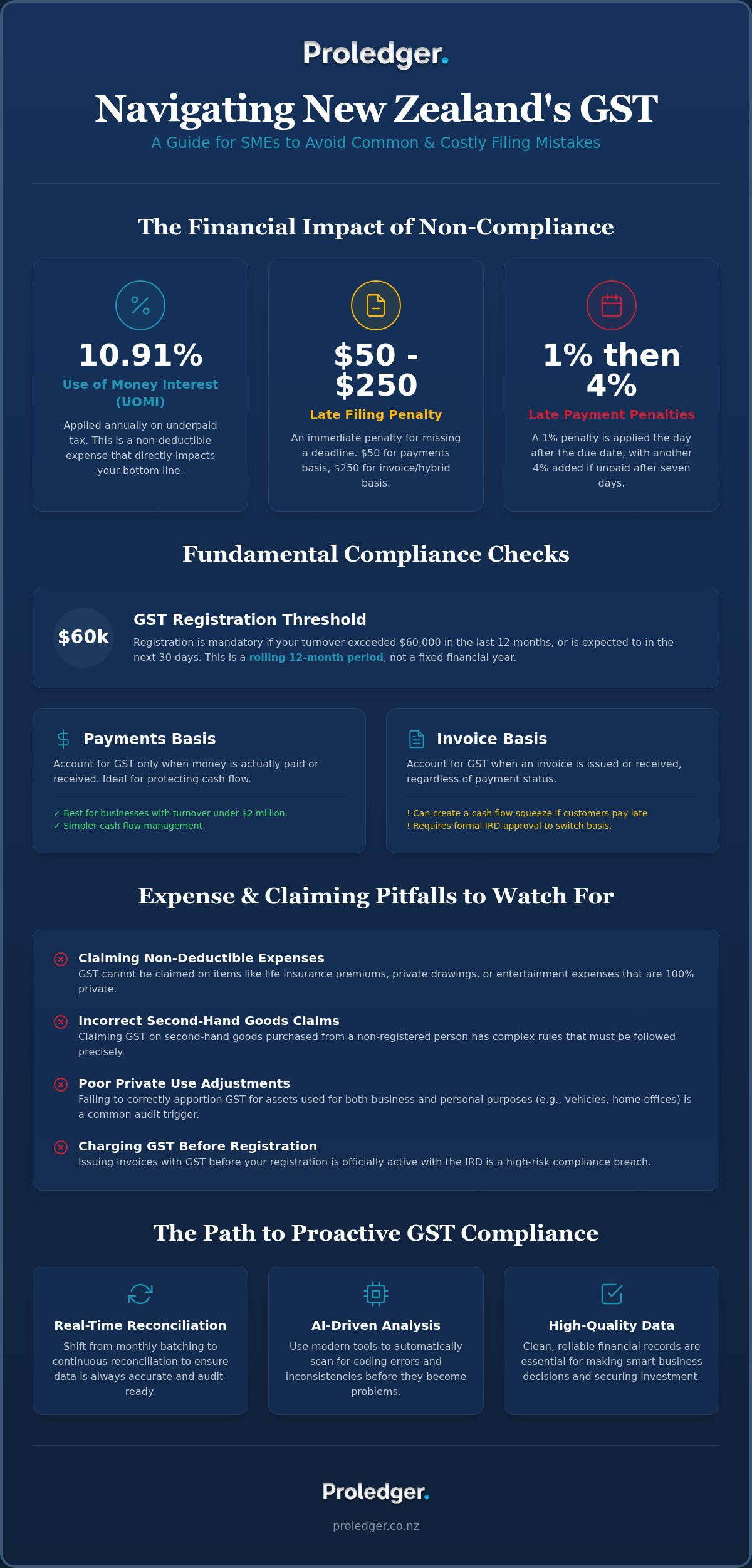
Inland Revenue applies Use of Money Interest (UOMI) at 10.91% per annum on any underpaid tax, which is a non-deductible expense that directly hits your bottom line.
The Financial Impact of IRD Penalties
The cost of non-compliance in 2026 is steep. Missing a filing deadline results in an immediate penalty of $50 for businesses on the payments basis, or $250 for those on the invoice or hybrid basis. Payment delays are even more punishing. A 1% penalty hits the day after the due date, with an additional 4% added if the debt isn't cleared within seven days. These charges, combined with monthly incremental penalties, turn small errors into major liabilities. Regularly amending returns also damages your standing with the IRD, potentially triggering more frequent and invasive audits.
Inaccurate Data: The Hidden Business Cost
Financial penalties are only half the story. If your GST coding is erratic, your Profit & Loss statements become unreliable tools for management. Making strategic decisions based on gross revenue rather than net figures can lead to dangerous overspending. For founders in Auckland or Christchurch looking to scale, clean books are essential. Investors and lenders expect to see a professional financial setup where GST is handled with precision. High-quality data ensures you have the clarity needed to lead your business with confidence.
Mechanical Mistakes: Registration, Accounting Basis, and Timelines
Mechanical errors often stem from a misunderstanding of IRD rules rather than simple arithmetic. Many founders assume the $60,000 threshold applies to a fixed financial year. In reality, it operates on a rolling twelve-month basis. You must monitor your turnover constantly. If your revenue has exceeded $60,000 in the past 12 months, or if you expect it to hit that mark in the next 30 days, registration is mandatory. Charging GST to customers before your registration is officially active is one of the most common GST filing mistakes NZ authorities flag as a high-risk activity.
The Registration Trap for Startups
Startups often face a dilemma regarding voluntary registration. Registering early allows you to claim GST back on significant setup costs, such as equipment or professional fees. However, it also adds an immediate administrative layer to your operations. For early-stage companies in Richmond and Nelson, we often recommend voluntary registration if your clients are other GST-registered businesses. This ensures your tax position is optimised from day one. If you're unsure which path to take, Proledger's GST and tax filing services can help you determine the most strategic timing for your registration.
Invoice Basis vs Payments Basis
Choosing the wrong accounting basis can create a severe cash flow squeeze. On the payments basis, you only account for GST when money actually changes hands. This is generally the safest option for small businesses with a turnover under $2 million. Conversely, the invoice basis requires you to pay GST to the IRD as soon as you issue an invoice, regardless of whether the customer has paid you. Switching between these methods isn't a simple toggle; it requires formal approval through the Inland Revenue Department GST portal and careful adjustment of your existing records to avoid double-counting or missed claims.
Filing frequency is another critical choice. While a six-monthly cycle might seem easier, it often leads to massive, unexpected tax bills that can cripple a growing business. Most SMEs find the two-monthly cycle provides the best balance between administrative effort and consistent cash flow management.
Common Expense Pitfalls: From Second-Hand Goods to Private Use
Distinguishing between business and personal expenditure is a frequent hurdle for many entrepreneurs. One of the most common GST filing mistakes NZ business owners commit is claiming for non-deductible items such as life insurance premiums or private drawings. These expenses don't carry a GST component that your business can reclaim. Similarly, entertainment expenses are typically only 50% deductible. Claiming the full amount is a guaranteed way to attract IRD attention during a review. For any claim exceeding $50, you must hold a valid tax invoice to justify the input tax credit.
Navigating Second-Hand Goods Claims
The "Second-Hand Goods" rule is a powerful but misunderstood provision. It allows you to claim GST on items purchased from non-registered sellers, such as buying a used computer from an individual on a local marketplace. However, the record-keeping requirements are precise. You must record the seller's name, address, the date of purchase, and a description of the goods. A significant error occurs when businesses claim this GST before they have actually paid for the item. Our AI bookkeeping tools are designed to flag missing documentation for these specific transactions, ensuring you only claim what you can prove.
Home Office and Motor Vehicle Adjustments
Apportioning costs for mixed-use assets requires a methodical approach. For home offices, you can choose between the IRD's square metre rate or a calculation based on actual costs like power and insurance. Motor vehicles require even more diligence. Unless a vehicle is used 100% for business, you must maintain a logbook for at least three months every three years to determine the correct GST apportionment. Many businesses overlook these year-end adjustments, leading to skewed returns. Proactive Monthly Reconciliation helps catch these discrepancies early, preventing a massive tax bill at the end of the financial year.
The Role of Real-Time Reconciliation in Filing Accurate Returns
Batching bookkeeping into a single monthly event is one of the primary drivers of common GST filing mistakes NZ businesses encounter. Waiting until the deadline forces you to rely on distant memories to categorise transactions, which inevitably leads to guesswork. A "Clean Books" approach requires reconciling bank feeds daily or weekly to ensure every transaction is fresh in your mind. While platforms like Xero or MYOB provide the infrastructure, they aren't a complete solution on their own. You must match physical receipts to digital transactions to ensure your input tax credits are audit-proof and fully justified.
Daily vs Monthly Reconciliation Workflows
Daily micro-tasks prevent the overwhelming end-of-period panic that leads to sloppy errors. Using automated bank feeds reduces manual data entry, yet it still requires human oversight to confirm the software has matched transactions correctly. This proactive habit ensures your financial position is always transparent. If you find the daily grind too demanding, our monthly reconciliation services NZ provide the professional oversight needed to keep your accounts in perfect order without the stress.
Catching Coding Errors Before They Reach the IRD
Miscoding remains a significant risk for SMEs, particularly with items that look like standard expenses but carry different tax rules. Common examples include:
- Bank Fees: These are generally exempt from GST, yet they're frequently coded as a standard expense.
- International SaaS Subscriptions: Many global software tools don't charge NZ GST, meaning you cannot claim a credit you haven't paid.
- Loan Repayments: Only the interest component might be relevant for other taxes, but the principal repayment certainly doesn't carry GST.
Setting up "Bank Rules" in your accounting software helps maintain consistency, but these rules must be reviewed regularly. For high-volume businesses in Auckland, a second pair of eyes is critical to ensure these subtle errors don't compound over time. Secure your business data today by exploring our AI finance automation solutions to catch anomalies before they become costly penalties.
Proactive Compliance: How Proledger Automates GST Accuracy
Legacy accounting often leaves founders reacting to problems rather than preventing them. Proledger flips this script by integrating AI-enabled finance automation into our core service. Our platform acts as a digital sentinel, scanning your transactions to identify common GST filing mistakes NZ businesses often miss, such as miscoded international subscriptions or incorrect second-hand goods claims. By automating the detection of these anomalies, we move beyond simple data entry into the realm of strategic accuracy.
We offer a "No Surprise" guarantee that provides absolute cost certainty for SMEs in Nelson and Christchurch. You won't face unexpected invoices for asking a simple compliance question. Instead, you receive a streamlined service where GST and tax filing are handled with clinical precision. This allows you to stop worrying about IRD audits and start using your tax data to gain deeper insights into your monthly cash flow. It's a shift from merely surviving tax season to using financial data as a tool for growth.
Fixed-Fee Accounting vs Hourly Billing
Hourly billing creates a barrier between you and your accountant. When every minute costs money, business owners hesitate to seek advice, which is often when errors occur. Our fixed fee accounting NZ model removes this friction. You gain the freedom to delegate your entire GST return process to experts who are committed to your long-term stability. This partnership ensures that critical financial functions are never neglected due to budget concerns. It provides the relief and clarity you need to lead your business with confidence.
AI-Powered Insights for Modern NZ Startups
Our technology provides more than just compliance; it delivers instant financial intelligence. By monitoring your records centrally, we act as a proactive ally that catches coding slips before they reach the IRD. This modern approach ensures your books are always audit-ready and your growth decisions are based on net, not gross, figures. High-scale infrastructure meets local expertise to give your startup a competitive edge. Book a consultation with Proledger to get your GST sorted and experience a partnership built on precision and modern efficiency.
Secure Your Business Future with Precise GST Management
Navigating the complexities of Inland Revenue requirements doesn't have to be a source of constant stress. By shifting from reactive "batch" bookkeeping to a proactive, real-time model, you effectively eliminate the risks associated with common GST filing mistakes NZ SMEs often face. Whether it's mastering the nuances of second-hand goods claims or ensuring your accounting basis is perfectly aligned with your cash flow, accuracy is your best defence against IRD interest and penalties. You deserve to focus on your passion, not your paperwork.
Proledger provides the infrastructure and expertise to handle your back-office functions with modern efficiency. Our expert NZ-based team brings over 20 years of experience to your corner, supported by AI-driven financial insights that catch errors before they become liabilities. With our predictable monthly fixed fees, you can finally say goodbye to surprise bills and hello to total financial clarity. Get your GST returns filed accurately with Proledger fixed-fee packages. Step into a more organised future where your GST returns are 100% accurate and your growth is backed by data you can trust.
Frequently Asked Questions
What is the current GST registration threshold in New Zealand for 2026?
The mandatory GST registration threshold for 2026 remains at $60,000 of taxable turnover within any rolling 12-month period. It is not based on the financial year, so you must monitor your revenue continuously. If you expect your turnover to exceed this amount in the next 30 days, you must register immediately to avoid penalties for late registration or failing to charge GST when required.
Can I claim GST on expenses if I am not yet registered?
You cannot claim GST on business expenses incurred before your official registration date. Only GST-registered entities are entitled to reclaim input tax credits from the IRD. This is why many startups choose voluntary registration early to recover GST on significant setup costs and equipment purchases before they actually hit the mandatory turnover limit.
How much are the Inland Revenue penalties for filing a GST return late?
Inland Revenue charges an immediate late filing penalty of $50 for businesses on the payments basis and $250 for those on the invoice or hybrid basis. Beyond filing, late payment penalties start at 1% the day after the deadline, increasing to an additional 4% after seven days. These costs can escalate quickly if errors aren't corrected promptly, making accuracy essential.
What is the difference between "Exempt" and "Zero-rated" supplies for GST?
Zero-rated supplies are taxed at 0%, allowing you to still claim GST on related expenses, while exempt supplies carry no GST and offer no claimable credits. Common zero-rated items include exported goods and services. Exempt supplies typically include residential rent and financial services. Misidentifying these is one of the common GST filing mistakes NZ businesses make during their initial setup.
Do I need to keep physical receipts for GST claims under $50?
You are not legally required to hold a full tax invoice for business purchases under $50, but you must still keep a record of the transaction. This record should include the date, description, and cost of the item. For any expense over $50, a formal tax invoice is mandatory to support your claim during an IRD audit or review. Digital copies are generally acceptable for record-keeping.
How does the "Second-hand goods" GST claim work for sole traders?
Sole traders can claim a GST credit on second-hand goods purchased from non-registered sellers for use in their business. You calculate this by taking the purchase price and multiplying it by 3 and then dividing by 23. You must maintain a detailed record of the seller's name, address, and the date of purchase to ensure the claim is valid and audit-proof.
Can I change my GST accounting basis from payments to invoice?
You can change your GST accounting basis, but you must apply for and receive approval from Inland Revenue before making the switch. This transition often requires complex adjustments to ensure you don't double-count or miss GST on outstanding invoices. Most small businesses prefer the payments basis for its superior cash flow benefits compared to the invoice method which taxes you before payment is received.
What are the benefits of a fixed-fee accountant for GST filing?
A fixed-fee accountant provides cost certainty and eliminates the fear of surprise bills for every compliance question you ask. This model encourages proactive communication, allowing your advisor to catch common GST filing mistakes NZ before they result in IRD penalties. You gain access to expert oversight and AI-driven insights that streamline your entire filing process while keeping your monthly overheads predictable.
Disclaimer
The information in this article is general in nature and has been prepared for informational purposes only. It does not constitute accounting, tax, financial, or legal advice, and should not be relied upon as such.
While Proledger Consulting Limited takes care to ensure accuracy at the time of publication, laws, rates, and regulations (including NZ tax and employment law) change regularly, and this content may not reflect the most current position.
Before acting on any information in this article, we recommend you seek advice tailored to your specific circumstances. Contact us at proledger.co.nz or speak with a qualified professional. Proledger Consulting Limited accepts no liability for any loss or damage arising from reliance on this content.
© Proledger Consulting Limited. All rights reserved.
Frequently Asked Questions
Related articles



Book a Free Consultation
Chat with Proledger about your accounting, GST, or bookkeeping needs — no obligation.
Book a Free ConsultationMeet Our Experts